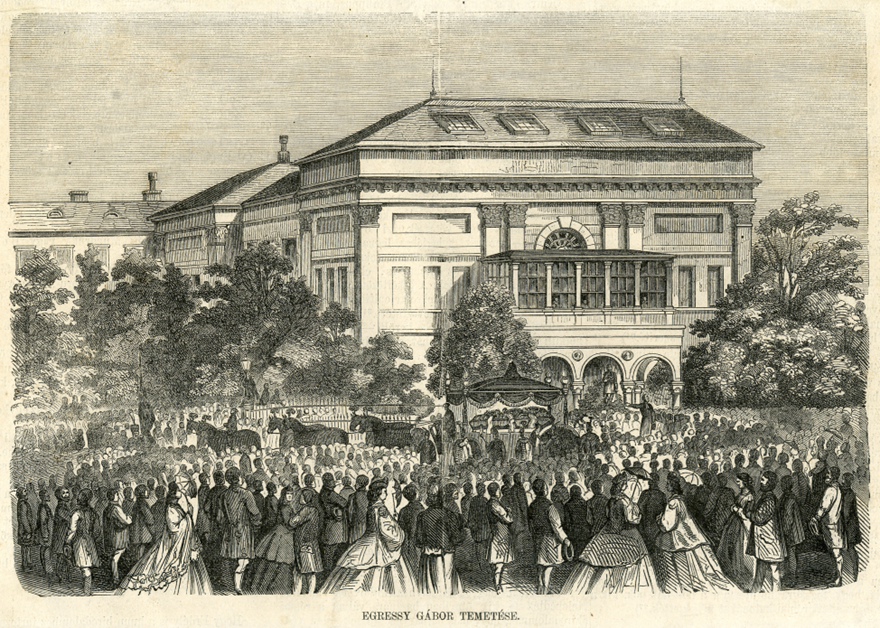
Mór Jókai published ten theatre reviews in the literary weekly Életképek between 2 January 1847 and 6 February 1848—as discovered by the staff of the critical edition of the author’s collected works (Jókai 1965). When Jókai began this work, Adolf Frankenburg’s name still appeared as editor on the title page; however, in July 1847, he took over the role, and less than a year later, he co-prepared issue number 19, published on April 30, 1848, with Sándor Petőfi.
Jókai was not very fortunate in his criticism, a fact he mentioned several times during his life. In his memoir titled Az én kortársaim (My Contemporaries), he claimed he didn’t understand “theatre criticism” and praised everyone excessively, which is why Frankenburg immediately dismissed him (Jókai 1926, 25–26). Indeed, after his third review published on 16 January 1847 in Életképek, there was a long break; he only resumed his series on National Theatre performances in July 1847. The writer recalled that the biggest complaint against his work was that he “overpraised” the actors, particularly by lauding Lili Szilágyi in Ede Szigligeti’s play Pasquil: “who, considering her young age, plays her short role quite skilfully and deserves ample praise; she shows no inclination towards affectation, which is why we take the liberty of promising her a very bright future from an artistic perspective, which we believe she will achieve with God’s help, her own diligence, and the will of those concerned” (Jókai 1965, 10). As the quote shows, Jókai did indeed promise the young actress a great future—but so did his fellow critics, who were well-versed in theatre criticism. Therefore, this enthusiastic tone alone could not have been the reason for Frankenburg’s decision. We must look for a much more serious reason to understand the editor’s decision. Jókai—although he accepted the task of evaluating National Theatre performances “for a free box seat and ten forints a month”—declared in his introductory article that he completely rejected the rationale behind literary and artistic criticism. He believed that critics, “placing clumsy spectacles on their noses, began to look for a knot on a straw, spoke meaningless things about aesthetics and art philosophy, took great strides in their cothurni, said everything that no one doubted, and when they were bored to death by the kindly reader: they cried out with proud self-esteem: behold my country, do not say that I lived in vain, I have split two hairs, I lay them on your altar” (Jókai 1965, 6).
Instead of the quibbling criticisms he labelled as hair-splitting, Jókai considered writings with a completely different perspective desirable. He formulated his principles clearly and unequivocally: “In my opinion, the duty of criticism is not to separate the darnel from the wheat, but rather: to bring to light the pearls where it finds them; because what is ugly, there is no need to point it out, any good soul will see it without it” (Jókai 1965, 7). And Mór Jókai had another very important statement, suggesting that the radical, oppositionist writers of Életképek viewed the National Theatre of the reform era as an important political factor. Jókai emphasized—since the institution had “not only artistic but above all national interests”—that he considered it his conscience’s duty to solidify the theatre’s “moral credit” through his writings to the best of his ability (Jókai 1965, 7).
It is likely that Adolf Frankenburg initially agreed with his colleague’s endeavor, but the writer’s heretical thoughts provoked such opposition among the staff of conservative newspapers—Nemzeti Ujság, Budapesti Hiradó—and the theoretical and critical weekly of the Kisfaludy Társaság (Kisfaludy Society), Magyar Szépirodalmi Szemle, that the editor had to reconsider the interests of Életképek, as this journal had been the official organ of the National Theatre since 1846. The editorial office could rightfully be accused of perhaps not holding back from serious critiques of performances for this very reason. Magyar Szépirodalmi Szemle also emphasised regarding its theatre section that “Életképek is the official theatre journal and thus can hold some authority before the public” ([Anon.] 1847, 208). And it was precisely for that reason that they received with incomprehension that the journal published “pearl criticism” ([Anon.] 1847, 209).
The disapproving remarks directed at the theatre column of Életképek certainly contributed to Jókai revisiting his views on criticism in his review of the Othello performance on 16 January 1847—albeit in a much milder form: “Yes: we believe that criticism is useful, that criticism is necessary; that everything that requires correction in matters of art or literature should be censured; but we flatly deny that this time should always be the readers’ time, and this place always the domain of journalism” (Jókai 1965, 26).
Mór Jókai’s first attempts published in Életképek in 1847 were not true critiques. Unfortunately, he also failed to fully realize what he initially promised. In his summary of Imre Vahot’s comedy Farsangi iskola (School at Carnival Time), published on 2 January 1847, we find no sentence alluding to pearls. Nor can praise be found in his lines about Ida Komlóssy: “Ida Komlóssy played the role of Veronka with a suitably charming rural clumsiness, and the critic feels no inclination to scold the esteemed lady’s peculiar headwear. Not at all. It is a matter of taste, a private affair, and he does not wish to interfere in such things” (Jókai 1965, 9).
However, it is striking how enthusiastically Jókai wrote about Gábor Egressy, who played the role of Firkászi in Ede Szigligeti’s play Pasquil, which premiered at the National Theatre on 21 December 1846. Életképek had already written about the performance at the end of 1846. In it, Ferenc Hazucha, who published his reviews under the pseudonym Andor Vas at the time, accused the author and the lead actor that the audience identified Firkászi with a well-known public figure, and “the matter could become personal, especially if the performing actor facilitates it” ([Hazucha] Vas 1846, 815).
We know from Ferenc Kerényi that Gábor Egressy repeatedly made his roles recognizable during his career by modelling them on specific individuals; for example, “the journalist Firkászi […] after the editor of Honderü, Lázár Petrichevich Horváth, who was widely disliked” (Kerényi 2005, 1094).
However, figures in the literary world at the time were not entirely certain, and as we read in Pesti Divatlap: “Through Egressy’s deeply moving performance, not one, but several writers felt themselves touched and struck” (Szinéri 1847, 29). Gusztáv Zerffi condemned the stage pamphlet in the harshest terms in the pages of Honderü: “The stage—oh God! how regrettable it is that there are writers and actors among us who, filled with arrogance from head to toe, overestimate themselves” (Zerffi 1847, 17).
Jókai took a stance on this issue by sincerely praising Gábor Egressy’s acting talent—“we never could appreciate him as much as he deserved”; and denied that it was a stage action against conservative literary taste (Jókai 1965, 8). He found the outrage accompanying Szigligeti and Egressy’s pamphlet amusing and made it clear that he had no objection to a politicizing National Theater and a politicizing Gábor Egressy.[1]
Mór Jókai’s early theatre reviews are not only different from the accepted critiques of the era due to their political charge. They suggest that what happens in the theatre should not be taken so seriously. And above all, the principles of dramaturgy and theatre aesthetics, on which extensive treatises were being written at the time, should not be taken seriously. His articles published in Életképek in early 1847 bear witness to his attempt to establish his own style in this genre, speaking in an original, individual voice. We believe he succeeded in this to some extent. Consider, for example, the opening of his review of Kalmár és tengerész (Merchant and Sailor), published on 9 January 1847: “Every week, it occurs to us five times that Lendvay is gone. If our actors truly have to travel for two months for studies to be gathered in the countryside: then let us close the theatre for two summer months, let them all travel at once, rather than at a time when the theatre is the only enjoyment for the public, one of our better actors turns his back on the institution” (Jókai 1965, 17). He then immediately moves on to reviewing József Szigeti, who took over Lendvay’s role: “Mr. Szigeti has a peculiar habit: when he wants to say something big, very big, he takes three steps back; when he wants to express surprise, he takes two steps back; when he wants to declare love, then only—four” (Jókai 1965, 17).
But how did the competing Pesti Divatlap report on the same performance? The reviewer, hiding behind the pseudonym Aladár, stated: “one cannot expect Szigeti to transform the naval lieutenant Endre Kelendfi into a character that Lendvay created with his emotionally rich and warm performance, because Szigeti has neither enough time nor enough acting skill for that. But how could he, when he is essentially an everyday performer at the institution for months, with only a few evenings as an exception, and it is difficult to divide his time in such a way that enough remains for him to learn his role. And roles need not only to be memorised, but learned” (Aladár 1847, 87). And so on, at length, in detail, excusing the actor.
It is no coincidence that Elemér Császár stated about the paper Életképek in his work on the history of Hungarian criticism that “the decline of the journal’s critical section, which was noticeable in the last year of Frankenburg’s reign, became sudden at this time. Like a boulder rolling down a mountain, it accelerated towards complete degradation with uniform speed. In the first half of Jókai’s editorship, the reviews shrank; in the second half, the first half of 1848, their number also decreased, and in the third half, we hardly find any criticism in the journal. And this quantitative impoverishment is matched by a decrease in the value of the critiques” (Császár 1925, 324). Indeed, Mór Jókai’s theatre writings in 1847 and 1848, in the period immediately preceding the revolution, were far removed from the domestic theatrical criticism tradition, which primarily took the works of József Bajza, József Garay, and Mihály Vörösmarty as its model. These essays, by demanding adherence to the laws of the genre, primarily critiqued the dramatic work and sought to idealize the stage presence of the first generation of actors at the National Theatre. We find no trace of didactic criticism in Jókai: he provides no advice to either writers or actors. However, if he is pleased with an artist’s stage performance, he expresses his delight with enthusiastic words. His review of Shakespeare’s Coriolanus, performed on 24 June 1847, is instructive in this regard, in which he virtually only praised Róza Laborfalvi.[2] This characterisation belongs in a study or monograph on Róza Laborfalvi, while other Jókai writings from this period will hardly be cited in theatre and drama history overviews examining the outstanding era of the National Theatre. Despite this, it is missing from Mór Jókai’s the history of the National Theatre that during the years of absolutism he frequently pointed out that this institution, from its founding, was considered one of the most important political organs. It is no coincidence that his novel Kárpáthy Zoltán begins with the celebration of the National Theatre’s opening. (The first chapter of the work was published in Pesti Napló on 16 May 1854.) And let us not forget Mór Jókai’s earlier thoughts, formulated on 28 June 1849, in Esti Lapok, according to which the “National Stage is not merely a place of entertainment for the Hungarian nation, but one of its domestic altars, where the people come to sacrifice” (Jókai 1980, 425).
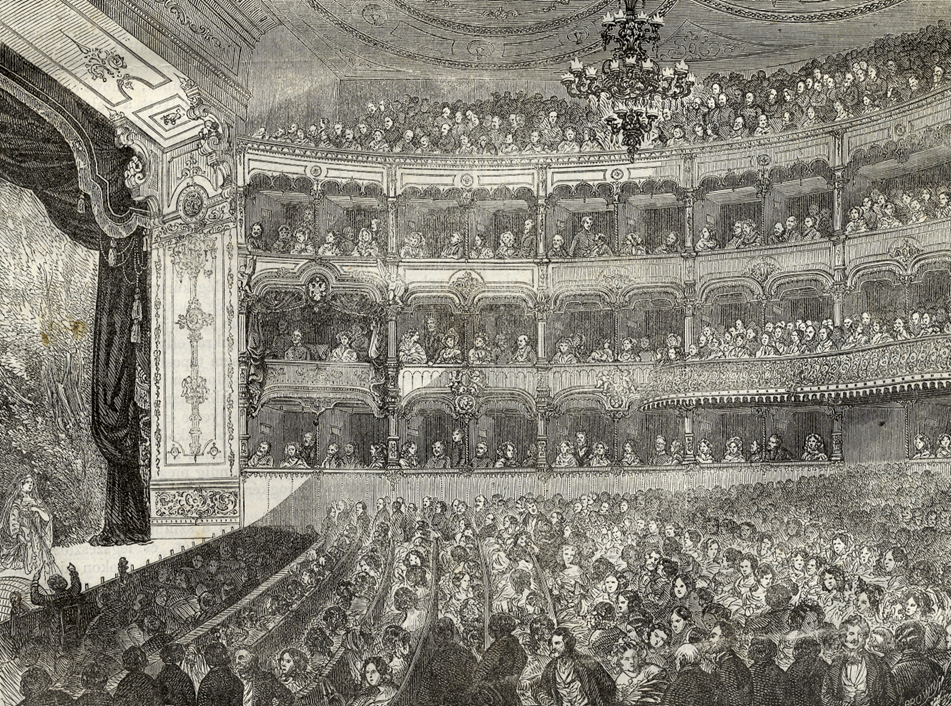
When Count Gedeon Ráday became director of the theatre again in December 1854, Jókai, three weeks later, on 14 January 1855, repeated his former sentences almost verbatim in Vasárnapi Ujság: “What is the Pest National Theatre to a Hungarian? Oh, very much! This is not merely a house of entertainment that brings us higher pleasure; it is a temple for us, where the most enduring altars of our nationality burn, a constant school of our civilization, the most certain testament to our existence, a blessed link that binds our elders and our young in interests, desires, and joys.” He also declared that “among all the factors that have made Pest a worthy capital of our country, the National Theatre is the most important” (Jókai 1968a, 135).
Picture 2. The auditorium of the National Theatre in 1855 (Vasárnapi Ujság, June 24, 1855).
These thoughts also explain why the situation of Hungarian acting and Hungarian dramatic literature occupied a prominent place in Jókai’s journalism, and why he repeatedly attempted theatrical criticism. We have already discussed what role the politicized intelligentsia assigned to the state-subsidized cultural institution during the reform era. The National Theatre—as Jókai’s lines demonstrate—was intended to fulfil this role even after the crushed war of independence. However, the theatre could not meet this expectation, as its direction fell into the hands of aristocrats loyal to the Viennese court, who considered their most important task to be—even at the expense of the national drama literature withering away—raising the standard of opera performance and popularizing ballet.
Another important turning point occurred around this time: Mór Jókai’s personal connection to the National Theatre changed completely, as in 1848 he married Róza Laborfalvi, the leading actress of the institution, and in 1853 he became a member of the drama judging committee. The writer needed an alter ego; he felt he could not sign his name under his theatre-related publications. The shift took place on 1 June 1856: on this day, the first letter from Márton Kakas, penned by Jókai, appeared in Gusztáv Heckenast’s cheaply illustrated popular newspaper, Vasárnapi Ujság, founded in 1854, titled “Márton Kakas at the Theatre.” The paper’s “newly hired” theatre critic introduced himself thus: “My intention is nothing less than to sign on as a permanent theatre correspondent for Vasárnapi Ujság. It is true that I have just arrived from the countryside, and yesterday I saw a play for the first time (I cannot say I heard it, as they performed a silent play—likely for the deaf), but another theatre critic has also opened with such an introduction, and I am saying nothing new. I have enough sophistication not to shout at the actress, “Let’s see what you can do, young lady!”; nor do I rush onto the stage when someone is about to be killed. The rest I will learn from other newspapers” (Jókai 1968a, 215).
The figure of Márton Kakas proved to be a perfect hit, as he represented the Hungarian countryside in every respect. It was not a classic theatre review that was born from his pen, but the rural readers would not have been interested in that anyway, as they had not seen the performance. However, many followed with interest what was happening in one of the most important national institutions. Jolán Kádár Pukánszkyné drew attention to the fact that in the 1850s, the social composition of the ground-floor auditorium in the theatre changed. Precisely the group that Márton Kakas represented disappeared from the National Theatre: “The minor nobility, withdrawn from official positions, went to the countryside, and although this class, with its patriarchal social life, was never a first-rate audience for the theatre, its absence was still felt. Its empty place was increasingly occupied by the honoratiores and the increasingly Hungarian bourgeoisie” (Pukánszkyné 1940, 180).
In his first letter, Márton Kakas, Jókai interpreted the National Theatre’s “silent play,” the five-act ballet Szerelmes ördög (The Devil in Love), which premiered on 20 September 1851, and has been performed with unbroken success ever since, in a way that suited the taste of those who stayed away from the theatre for political reasons. The writer ridiculed this type of spectacle, while at the same time noting details that are important sources for the history of Hungarian ballet performance.[3]
Jókai’s literary feat is that he appears in the letters, because he himself is often present in the audience. On the first occasion, he sat next to Márton Kakas as an unfit old gentleman who “grumbled throughout the entire performance” (Jókai 1968a, 218): “…so is this the purpose of the National Theatre, to fill the entire evening with leg-fiddling? What service do such empty spectacles provide for the moral development of the people, the expression of good feelings, and their taste? Yet, these would be the goals of such an institution as the National Theatre of Pest, and not the stimulation of the audience’s jaded senses and other such things. I could not silence him; finally, I told him that if he made too much noise, I would hand him over to the ticket collector, and he would not get any more admission tickets.—Did I do well?”
Speaking about the birth of the Márton Kakas figure in 1860, in an article titled “Ki hát az a Kakas Márton?” (“Who is Márton Kakas?”) in the newspaper Üstökös, Jókai revealed that he detested writing criticism: “…I wonder why in Muscovy, instead of lead mines, mortal sinners are not sentenced to theatre critic trench work” (Jókai 1968b, 332). Perhaps this is why he invented such an entirely unusual way of reporting on theatrical performances. According to István Fried, Jókai thereby introduced a new genre, “he experimented with less academic criticism, ranging from gentler humour to sometimes crasser self-ironic performance to satirising reports, at most approaching the more accustomed, objective tone with the depiction of outstanding actor personalities and guest performers” (Fried 2024, 74). One important characteristic must be added to Fried’s brief, insightful footnotes: these letters often inform us about how theatregoers relate to the repertoire. Jókai did not invoke the audience solely for the sake of his humorous presentation; he considered the opinions of viewers to be at least as important as the objections of critics. Not to mention that he brilliantly depicted the types of people who sat in the stalls, boxes, and galleries with a few excellent character sketches.
Jókai Mór wrote his theatre reviews as Kakas Márton for Vasárnapi Ujság for five years, from 1856 to 1861, initially on a weekly basis. Later, as letters were also written on other topics, these writings were published under the series title “Kakas Márton levelei” (“Letters of Kakas Márton”) in the “Tárház” column by Pákh Albert, the paper’s editor-in-chief. If the numbering was not mistaken, a total of one hundred and thirty-five (CXXXV) letters were published. The hundred and thirty-first (CXXXI) was the last one dealing with theatre, on 25 November 1860. Those interested could read Kakas Márton’s grumbling one more time on 21 July 1861. He picked up his pen in outrage because a French company was guest-performing Offenbach’s works at the National Theatre. He rightly felt that an unprecedented event had occurred, as musical works consisting of waltzes were being staged. Moreover, the composer had mixed French jargon with German lyrics! “What does he know of German words to us?” the critic exclaimed. Then he came up with a solution: “After all, it is high time that productions in a foreign language come to an end on the Hungarian national stage. The country raised this theatre for national purposes; it demands those from it” ([Jókai] 1861, 344).
Several pieces in the series made readers acquainted with Jókai Mór’s views on the National Theatre. During the period of absolutism, censorship prevented political issues from being discussed, but it was possible to talk about operas and ballets dominating the theatre’s repertoire, while original (i.e., contemporary Hungarian) dramatic works were staged much less frequently. These reviews, of course, could also remind readers of the ideal state when representatives of the radical intelligentsia, who were enthusiastic about the ideas of the bourgeois revolution, could participate in shaping the repertoire as playwrights, actors, and directors.
Similarly, mentioning the name of Egressy Gábor was considered a political act, as the whole country knew what an important role the actor played in the 1848–1849 revolution and war of independence, and that he was a leading actor and director of the National Theatre from its founding. Jókai, when discussing the performance of Obernyik Károly’s György Brankovics, praised the actor’s performance with rapture, just as he had in 1847. At the same time, emphasising the naivety of Kakas Márton, he jabbed at his fellow critics, who often criticized Egressy: “I don’t understand the rules of art; I can only judge what I see and feel. I can only say that I cannot imagine a nobler, more lifelike, more true-to-life character in every movement than Egressy was as the old Serbian prince, and I believe only in the emotion that sounded from his voice, what his face expressed. When he was angry, I trembled; when he cried, I cried with him, and it didn’t occur to me that this was acting, that this was art; I thought it was all true; and it seems the audience was of the same opinion as me, because throughout the entire play, there was such unprecedented clapping, such activity of hands, eyes, and handkerchiefs, that if this is not a sign of approval, then I don’t know what is?” (Jókai 1968a, 225–226).
As a sign of some weakening of the absolutist regime’s power, in the second half of the aforementioned hundred and thirty-first theatre letter in November 1860, Jókai Mór formulated an indictment in defence of Hungarian-language theatre. He exposed that the municipal authorities of Buda and Pest were supporting German actors and striving to push the Hungarian company into the most adverse financial circumstances. He also gave an example of how censorship interfered with the theatre’s repertoire: “The performance of foreign plays causing great sensation is permitted on the German stage, but banned on the Hungarian, and they only agree to it when it has been completely worn out there (this happened with Ravennai viador [The Warrior of Ravenna], which was held back from the Hungarian stage because the Hungarian audience would understand ‘Hungarian’ almost everywhere the word appears: ‘German,’ and instead of ‘Roman,’ they would understand: ‘Austrian’)” (Jókai 1965b, 431–432).
Most of Jókai’s Kakas Márton reviews naturally dealt with the performance of the staged plays, and there were hardly any of the presented works that he praised. It is striking that alongside many witty, satirically sharp critiques, he spared the works of some playwrights, such as Ede Szigligeti. True, he remembered the actor and playwright’s work, Mátyás fia (Son of Matthias), in a somewhat unconventional way on 14 December 1856. He claimed that on the evening of the play’s premiere, he had dinner with his fellow critics at Komló-kert, and while they wrote serious articles about the premiere, he could only report on the menu: “So, I humbly beg:—since I was there where the others were:—I confess that the first act: the stew meat went down a bit quietly. It was a good idea by the author, by the way, to include gnocchi with it.” Then, mentioning all the acts and dishes, he concluded his report: “Here, in good conscience, I have written this review. My report may be the weakest of all, but one thing is certain: it is the truest” (Jókai 1968a, 193).
A few months later, when discussing the premieres of two Szigligeti dramas—A mama (The Mother; April 17, 1857) and Béldi Pál (Pál Béldi; April 27, 1857)—he praised the author (Jókai 1968a, 370–371 and 394–396). Not to mention that he published a lengthy tribute to him in Vasárnapi Ujság under the signature Jókai Mór (Jókai 1968a, 367–370). The question of historical authenticity was already one of the central themes of Hungarian literary criticism at that time. Almost all publicists criticised Szigligeti Ede because he “erred in history by portraying Mihály Teleki as a well-intentioned, honourable man” (Jókai 1968a, 395). Jókai’s outburst reveals much about this dilemma: “If someone thinks that the stage is for people to learn history, then you can also convince them that people buy calendars because they learn to plough from them!” (Jókai 1968a, 394).
In most of his Kakas Márton writings, Jókai Mór tried to remain faithful to the worldview, anecdotal style, and way of thinking of the feigned author. However, there are some details where there is no trace of parody. The direct style addressed to the editor remains—but the information, arguments, and conclusions of the letter’s author are now those of the capital’s theatre critic. We could explain this by assuming that Kakas Márton acquired deeper aesthetic knowledge from his learned colleagues, but the following sentences convince us that besides poking fun at theatrical life, Jókai also took care to argue seriously while criticizing phenomena important to him. He did so, for example, when he believed that the task of the theatre management should be to contract actor personalities for the National Theatre, rather than mechanically filling roles: “Because I don’t think that the company consists of eight people; and for a theatre, if there is a lover, a hero, a comic, a kind father on the male side, and on the other hand, a lover, a heroine, a mature lady, and a quirky lady from the crinoline gender, then every category is filled. Indeed, I believe that for every kind of personality—I mean talented personality—there is a corresponding role category on stage” (Jókai 1968a, 509–510).
In contrast, when the National Theatre staged Jr. Alexandre Dumas’s La Dame aux camélias under the title Gauthier Margit (Margit Gauthier) on 26 November 1855, as a benefit performance for Lilla Bulyovszky, Jókai Mór knew how Hungary, whose mentality Kakas Márton authentically represented on the pages of Vasárnapi Ujság, would react to this play. He played with the thought of what would happen if the critic arrived at the theatre with a child of a distant relative: “I thought: they’re giving a tragedy, it can’t hurt him,” he remarked (Jókai 1968a, 277). Then, when it turned out that the heroine of the work was a prostitute and what the story was about, he concluded the letter: “I do not demand that the management not stage similar plays, if such a play suits the taste of today’s audience, but at least they should put on the playbill in similar cases: ‘no admission tickets will be sold to youth under twenty years of age for today’s performance,’ then I will be satisfied” (Jókai 1968a, 278). (The author seemed to already sense that at the beginning of the 20th century—in Debrecen, for example, from 1910 onwards—theatre directors would indicate ‘frivolous plays’ with red playbills.)
In Jókai’s journalism, theatrical writings dried up from 1861 onwards. As the political situation eased, the writer plunged into public life, where theatre matters were relegated to the background for a considerable time. Some of his theatre reviews still appeared, but he considered it much more important to influence public opinion with his articles. In the 1861 parliamentary elections, he became the representative for the town of Siklós and a member of the Resolution Party faction in parliament. This marked the beginning of a new chapter in his life.
Mór Jókai’s work as a theatre critic was viewed with suspicion by posterity and evaluated ambivalently. True, few took the trouble to read his publications in depth. They were content with the quoted anecdote found in recollections of Jókai. Jolán Kádár Pukánszkyné, on the other hand, completely misinterpreted the writer’s work as a theatre critic. She wrote that he belonged to those critics working in fashion magazines and daily newspapers who ‘increasingly’ got lost in the ‘witty manner,’ of which Saphir Móric Gottlieb was a highly influential master. This style places wit for its own sake before the search for truth and gradually loses all moral seriousness and all impact: it only offends, but it does not improve” (Pukánszkyné 1940, 176).
However, Jókai Mór was never offensive, and although his writings about the National Theatre are amusing, their moral seriousness remained.
[1] “There are gentlemen who are displeased with everything; there are gentlemen who consider the bread of unsolicited advocacy very tasty, and these find monstrous allusions to public figures in this role, and attack and defend the individuals with indignant philippics. For my part, if I were among the latter, I would not even thank them for such defence.” (Jókai 1965, 9.)
[2] “Laborfalvi R. (Mother of Coriolanus) is the most outstanding in this role; in scenes like this, where the respectable Roman matron comes to her son in the camp and speaks more than begs, she is unsurpassable. Miss Róza is the most beautiful stage figure, but only where her role touches upon true grandeur; the direction should appropriately utilize our artist’s rare talent only where it is truly required. Miss Róza is mediocre, incapable of elevating roles that are not motivated or pseudo-grand—her strength lies in conveying true goodness.—Thus, the young lady always errs when she applies the tone and gestures with which she earned crowns in grand roles to roles in which there is nothing grand beyond the words—grandeur is not inextricably linked to dark clothing.—Mother Coriolanus… and not to mention, the Marquise d’Auray in Paul Jones, these are two roles that make Miss Róza unforgettable to us.—May the young lady be jealous of these roles. These are not roles with which we do good by sometimes giving them to beginners—otherwise, it happens as it did the other day (in Angelo), that beautiful pagan converts come in.” (Jókai 1965, 201.)
[3] “A great lord comes out, takes one step to the right, one to the left, meaning he is looking for his servant. He shakes his leg, which was a ringing: the servant heard it and came in. The lord lifts his left leg: with this, he asks where the coffee is. The servant extends his leg backward, with which he says they won’t give coffee at the café until the old bill is paid. The lord then spins with his extended leg like a spindle, which means: but when there is no money-minting institution in the whole world where they would print banknotes for him.” (Jókai 1968a, 216.)
References
- Aladár. 1847. “Nemzeti Színház: Télhó 5: Kalmár és tengerész.” Pesti Divatlap 1: 86–87.
- [Anon.]. 1847. “A három divatlapról.” Magyar Szépirodalmi Szemle 13: 207–210.
- Császár, Elemér. 1925. A magyar irodalmi kritikai története a szabadságharcig. Budapest: Kisfaludy Társaság.
- Fried, István. 2024. Jókai Mór életrajzai és más furcsaságok. (Jókai Mór életrajzai III.) Szeged: Tiszatáj Könyvek.
- [Hazucha, Ferenc] Vas, Andor. 1846. “Nemzeti Színház.” Életképek 26: 813–816.
- [Jókai, Mór]. 1861. “Kakas Márton a szinházban: A francziák Pesten.” Vasárnapi Ujság 29: 344.
- Jókai, Mór. 1926. Az én kortársaim: 1848-as emlékek. Introduction and notes by Dr. Antal Prónai [Budapest]: Révai.
- Jókai, Mór. 1965. Cikkek és beszédek, Volume 1 (January 2, 1847 – March 12, 1848). Compiled and edited for publication by László Szekeres. (Jókai Mór összes művei.) Budapest: Akadémiai Kiadó.
- Jókai, Mór. 1968a. Cikkek és beszédek, Volume 4 1850–1860. Part I. Compiled and edited for publication by Györgyi H. Törő (Jókai Mór összes művei.) Budapest: Akadémiai Kiadó.
- Jókai, Mór. 1968b. Cikkek és beszédek, Volume 5 1850–1860. Part II. Compiled and edited for publication by Györgyi H. Törő (Jókai Mór összes művei.) Budapest: Akadémiai Kiadó.
- Jókai, Mór. 1980. Cikkek és beszédek, Volume 3 (February 9, 1849 – July 6, 1849). Compiled and edited for publication by László Szekeres. (Jókai Mór összes művei.) Budapest: Akadémiai Kiadó.
- Kerényi, Ferenc. 2005. “Valóság és dramaturgia: A régi Pest-Buda a reformkori színművek tükrében.” Holmi 9: 1088–1101.
- Pukánszkyné Kádár, Jolán. 1940. A Nemzeti Színház százéves története. (Magyarország újabbkori történetének forrásai.) Budapest: Magyar Történelmi Társulat.
- Szinéri. 1847. “Nemzeti Színház: Pasquil.” Pesti Divatlap 1: 28–29.
- Zerffi [Gusztáv]. 1847. “Pasquil: Didaskalia.” Honderü 1: 15–18.