László Beöthy, who, in addition to managing the Király Theatre, took over the administration of the Magyar Theatre in the autumn of 1907, had already announced a triple playwriting competition in the autumn of the previous year with a view to enriching the repertoire of his future theatre. The competition called for the writing of a play based on Ferenc Herczeg’s short story, Szíriusz, Kálmán Mikszáth’s novel, Szent Péter esernyője, and Mór Jókai’s novel, Az új földesúr. The competition organiser only had one comment: operetta or musical play scripts were excluded from the competition, indicating that the Király Theatre would not be staging the play. A great number of entries were received, seventy-two in total. Thirty-three entries were submitted for Szent Péter esernyője, twenty-eight for Az új földesúr and sixteen for Szíriusz. The committee originally appointed to evaluate the entries underwent some changes[1] and consisted of the following members: László Beöthy, Ferenc Herczeg, Ernő Salgó, Samu Fényes, Béla Vágó, Imre Szirmai and György Szemere. The professional jury judged the submitted works primarily from the perspective of staging, as the theatre planned to present the best ones. Although the promised prize of two thousand koronas for the best entries was not awarded, the committee members felt that each of the three competitions yielded a work that, due to its significantly-higher-than-average quality, was worth staging with certain changes and dramaturgical interventions. László Beöthy finally decided that the theatre would present the three best works, and if the audience responded favourably to them, the authors would receive the prize money. Among the adaptations of Jókai’s novels, the highest quality was that of Sándor Hevesi, while the committee awarded the prize for the comedy written by Imre Földes, based on Ferenc Herczeg’s short story Szíriusz. Among the adaptations of Szent Péter esernyője, it was Ferenc Martos’s work that won Beöthy’s committee’s favour. The director started the season with the latter. Kálmán Mikszáth, who was not fond of the theatre, was not particularly pleased that the Magyar Theatre company was staging his Szent Péter esernyője. He did not like the fact that his favourite character in the novel, the inconsiderate Gregorics, had been removed from the play, and he also found it strange that the author of the play did not include his own name in the programme. Ferenc Martos was known to the audience of László Beöthy’s other theatre, the Király Theatre, as the author of librettos for successful Huszka operas (Bob herceg [Prince Bob], Aranyvirág [Golden Flower], Gül baba). Martos may not have been confident of the success of the adaptation of Mikszáth’s work and felt that it might harm his career as a librettist if his name appeared on the programme for a contest with an uncertain outcome. But it could also be that Beöthy wanted it that way. In any case, the play was not a success. Although all three entries were scheduled to be performed during the 1907/1908 theatre season, the company of the Magyar Theatre did not perform the other commendable entry, the adaptation of Herczeg’s Szíriusz, until the beginning of the following season, on October 9, and the adaptation titled Az új földesúr was not performed until six years later.
Let us see what could have been the reason for these delays. László Beöthy had an excellent eye for talent, recognising which actors and actresses could make his theatre popular and profitable, and he was willing to take risks with young writers he considered talented. One such author was Imre Földes, whose play A császár katonái (The Emperor’s Soldiers) had been sitting in Beöthy’s desk drawer for months. Although the theatre director recognised the value of the work, as the head of the Király Theatre, he could not stage a prose work in the operetta theatre. However, after taking over the management of the Magyar Theatre, he presented A császár katonái to the public on 15 February 1908, while postponing the production of Imre Földes’s new play, Szíriusz, written for the competition, until the beginning of the following season.
In A császár katonái, the author professed his belief in the Hungarian national ideals and the efforts to establish an independent Hungarian army. The patriotic production, which strengthened national sentiment, became one of the theatre’s most successful plays within a few months. By the time Herczeg’s work was premiered, the young author had already been through a series of highly successful performances that attracted large audiences. The 1907/1908 season saw sixty-one performances of Földes’s drama, and a further forty-one performances by August 1910.[2] Beöthy could now hope that the young writer’s competition play would also attract audiences. But Szíriusz was not nearly as successful. Perhaps it was precisely because of the lack of interest in the two winning entries that the third, an adaptation of Jókai’s work, was ultimately postponed.
Regarding the postponement of the premiere of Az új földesúr, Hevesi recalled in a statement made a decade later that Beöthy was afraid to stage Jókai’s novel, and even six years later, it was only through his persuasion that the work was finally staged.[3] If Hevesi is right, the director was actually afraid of the theatrical failure of Jókai,[4] a writer who was highly esteemed by László Beöthy and his family. What could have been in favour of the presentation was the fact that there had been commemorations shortly before on the occasion of the eightieth anniversary of the writer’s birth, and the fact that Az új földesúr was republished at the end of 1905. In any case, the work was included in the planned theatre season of the Magyar Theatre for 1909/1910. The researcher suspects that there may have been personal reasons behind this decision. When Beöthy took over the Magyar Theatre, he lured several actors away from the Thália Company. This is how Jenő Törzs, Márton Garas, Rózsi Forrai, and after a short detour, Giza Báthory joined his theatre. The future of the Thália was extremely uncertain anyway, and Hevesi, as the spiritus rector of the company, did not look with approval on Beöthy’s activities in this regard. As is evident from his letter to Lajos Fülep, he did not think much of the Magyar Theatre’s programme: “The Thália was almost frozen out by its many enemies. Fortunately, we will still be able to open next week: with Ibsen’s Ghosts. It is about time—terrible conditions. Beöthy [wants] dramatic theatre: with László Márkus, Viennese obscenities, Sudermann and Rostand. That is literature for him.”[5]
Hevesi’s indignation is somewhat interpreted by another letter written a year and a half earlier by László Bánóczi to György Lukács (see Török 1988, 116): “You probably know about Beöthy’s plan. In the autumn of 1907, he takes over the Magy[ar] Th[eatre] and is going to turn it into a ‘literary theatre.’ He has not yet negotiated with Hevesi, and he does not think he will. I told him to recommend R[ózsi] F[orgács] to Beöthy.”
It can be assumed that Hevesi did indeed expect to play some kind of role at the Magyar Theatre, since it was Beöthy who launched Hevesi’s career as a director when he hired him for the National Theatre in 1901.[6]
Finally, the premiere of Az új földesúr took place on 6 September 1913. Even after a delay of six years, the director did not forget to indicate under the title that the play had been recommended for a prize in László Beöthy’s drama competition. Jenő Törzs played the title role, General Ankerschmidt, Ilona Cs. Aczél played the General’s eldest daughter, Hermine. Other actors included Béla Vágó, Rózsi Forrai, Mici Haraszti, Mihály Papp and Ernő Tarnay. Mihály Kertész, the film director who later became world famous in America, portrayed Straff, the fake Petőfi. The director and designer of the production was László Márkus, who by then had become a major theatre professional, having directed L’Aiglon, Hamlet, Faust, as well as works by G. B. Shaw, Oscar Wilde and Hungarian authors, including Lajos Bíró’s Sárga liliom (The Yellow Lily). He was the first to stage Miklós Bánffy’s drama A Nagyúr (The Great Lord) in Hungary.
Hevesi spoke highly of Jókai, and was rather modest about his own work as a writer:
“Az új földesúr is so human, so direct, and with all its colour and warmth, so realistic and psychologically constructed, that when it came to adapting it for the stage, it never occurred to me to rework, reshape, or recast Mór Jókai. I was convinced that, despite all tradition and custom, art and reverence coincided completely on this point, and I could do nothing smarter than to extract or copy the play from Jókai’s beautiful novel. There is not a single scene in the dramatized version of Az új földesúr that is not taken from Jókai’s novel, and wherever I had to add dialogue, I used Jókai’s words and sentences. My work was therefore entirely mechanical and scenic, without any literary affectations or pretensions. If Jókai’s classic novel appeals to the audience in this form, I have no part in it, because what happens is that the great novelist’s magic power has not diminished on stage. But if the audience did not like the dramatised version of Az új földesúr, it would be my fault, because in that case it would mean that I was unable to convey Jókai’s values on stage.”[7]
Jenő Törzs spoke about the possibilities of portraying his role, about how he would like to show the Hungarianisation of Ankerschmidt’s character:
“My tools on stage are words and voice. So, I use these two props to make my Ankerschmidt Hungarian. I speak in a German accent. This is a concession that I am forced to use. In fact, Ankerschmidt’s environment is exclusively German and speaks German. In the play, every word spoken by the Ankerschmidt family and their environment is German. If I speak Hungarian correctly, it means that I spoke German correctly. But when the general stands opposite the bailiff, Mr. Kampós, who offers his reapers in rich Hungarian, how can the Ritter’s German identity be made apparent in this discourse other than through his German speech? If both of them speak good Hungarian, which of the two is the one who is becoming Hungarianised…”[8]
Some critics considered Jenő Törzs, who was in his mid-twenties, too young for the role. “Törzs played General Ankerschmiedt, a rough old officer. However talented an actor Törzs may be, and however much effort he puts into playing these characters who are so far away from his age and physical appearance, such characters of his still make the impression of being half or, let’s say, three-quarters of the job. His portrayal of Ankerschmiedt also reminds us of when, in the Orpheum, the ‘gesangskomiker’ appears after all kinds of transformations as an old man with trembling knees, singing a melancholy song. The production is excellent, but one still gets the feeling that this old man is being portrayed by a twenty-five-year-old body. And this feeling becomes conscious when one sees how Törzs attempts to compensate for his imperfect overall impression by accumulating all kinds of movements intended to characterise generals. I repeat, however, that it was still interesting, appealing and effective,”[9] wrote Zoltán Szász, critic of the Pesti Hírlap.
Two days after the premiere, on 8 September, a statue of Jókai was unveiled in Komárom, where Géza Sebestyén mentioned how warmly the audience of the Magyar Theatre had welcomed Az új földesúr in its dramatised form.[10] And while the audience enjoyed the show, not all of the post-premiere reviews were pleased with Hevesi’s dramatisation:
“We have long known that it is impossible to adapt a novel for the stage, and Jókai’s works are particularly unsuited to this task. In his writings, action is actually nothing more than a framework, a skeleton, which is brought to life by the milieu, the thousands of episodes, and the narration. Sándor Hevesi’s work is further proof of this old truth. He worked honestly and conscientiously, even striving to keep the dialogues intact. But how different the novel is! He tried to give a truthful picture and even included excerpts from the episodes, but his undertaking was like that of a boy who wanted to empty the sea with a shell. Jókai’s novel is at least ten times as long as this play, yet the novel is full of delight, while the play seems long and tiresome. It was a failed venture. It looks like someone cut out individual figures from a large, very complex painting, then put them together and stitched them into a new frame. Something is missing from the play, the heart, the warm pulsation of blood, the inexplicable magic with which the words of true personalities affect us. We do not feel the poet’s unity with his work, we do not feel the sacred immersion in the work, we do not feel what the dialogues planted in the play do so wonderfully, we do not feel the beating of the genius’s heart. This is not Sándor Hevesi’s fault, but rather that of the genre, if a play adapted from a novel can be described in this way. The actors delivered an excellent performance. Törzs, however, ruined his otherwise magnificent performance by trying to decipher the figure of Ankerschmiedt with intelligence.”[11]
It was common practice for provincial theatres to reproduce the programs of theatres in the capital. Two weeks after the premiere in Pest, the press reported that the play was also being rehearsed in Kolozsvár. On 1 October 1913, the National Theatre of Kolozsvár premiered Az új földesúr, directed by Jenő Janovics, about which the reporter wrote, “The novelties from Budapest quickly find their way here with excellent sets and clever technology. That is what all the state subsidies go for. In the production of Az új földesúr the thunder, lightning and thunderstorms seen (and heard) through the window were so faithfully imitated that many of us began to wonder how we were going to get home in the rain.”[12]
On 12 October, the play was performed by János Komjáthy’s company at the National Theatre of Kassa, and a year later, Tivadar Abonyi’s production was also staged at the Franz Joseph Municipal Theatre of Temesvár.
However, the idea of staging Az új földesúr had been mooted before Beöthy’s drama competition. The 21 November 1903 issue of the Miskolczi Napló mentions that Albert Kövessy, the agile director of the Kecskemét theatre, dramatised Mór Jókai’s novel Az új földesúr. The great writer had read the play and was very pleased with it, of which he assured the author in writing.[13] The newspapers also reported Jókai’s approval:
“Authorization. Whereby I authorize theatre director Mr. Albert Kövessy, to dramatise and stage my novel ‘Új földesúr,’ subject to my joint copyright; having carefully read the finished play and found it satisfactory on my part. Yours truly, Dr. Mór Jókai.”[14]
Kövessy became head of the Kecskemét theatre in 1900. Jókai’s letter of support dated 16 January, addressed to József Szeless, the chairman of the theatre committee, may have played a role in his election (Joós 1957, 144–145):
“Dear Mr. President,
I have the courage to recommend to your esteemed patronage Mr. Albert Kövessy, theatre director, who currently manages the Kisfaludy Theatre of Óbuda, and who I believe to be one of the most skilled theatre directors, with a well-organised company to perform drama, comedy, opera, operetta, and folk theatre plays with first-rate artists.
I kindly ask you to promote the theatre director’s desire to be awarded the management of the Kecskemét theatre for this season.
With utmost respect,
I remain your loyal supporter,
Dr. Mór Jókai”
Albert Kövessy’s dramatisation of Az új földesúr and his promise to stage it can be interpreted as a gesture of gratitude. And indeed, it remained a promise, because he did not stage it then or later, and without knowing the script, we cannot form an opinion on its theatrical quality. But what or who prompted Jókai to support Kövessy? Albert Kövessy rented the Kisfaludy Theatre of Óbuda from the end of October 1898. And as Jókai also points out, the two years he spent there can indeed be considered successful, especially after the failure of the previous director. Lajos Serly, the builder and first director of the theatre, disheartened by a lack of interest from the audience in Óbuda, retained ownership of the theatre and handed over its management in exchange for a rent. That’s how Albert Kövessy came to run the theatre. Jókai’s knowledge of the theatre’s repertoire was no doubt thanks to his future wife, Bella Nagy, who was performing at the Kisfaludy Theatre of Óbuda as a guest in Kövessy’s company. We can assume that the young fan of Jókai’s got a role in the theatre with the writer’s support.[15] That is why it was not a burden for Jókai to write a few lines of support.
In 1917, Az új földesúr was performed for the fiftieth time, with a revised cast. At that time, Egy magyar nábob was already in production, at the initiative of Hevesi, who, remembering Az új földesúr, commented on the newly made adaptations of the novel:
“The show was an unexpected success. Jókai’s genius was constantly celebrated by packed houses at the Magyar Theatre. Then another couple of years passed. Three years later, I brought it to Beöthy’s attention: now, in wartime, would be the right time to bring Jókai’s refreshing personality closer to the Hungarian public. For my part, I suggested the dramatisation of ‘Egy az isten’ [Manasseh: A Romance of Transylvania / One is God], but Beöthy opted for ‘Egy magyar nabob.’[16] His decision was vindicated by success. And now there was no other choice but to continue with the natural sequel, ‘Kárpáthy Zoltán.’ Its production was also a complete success. And since the premiere, I have already done the dramatic version of ‘A kőszívű ember fiai,’ and because of the huge material, not in one but in two plays, one titled ‘1848’ and the other ‘1849.’ This season, the two plays will be presented as a cycle.—A very big job is now fully completed with this cycle to be presented. ‘Egy magyar nábob’ brings the twenties of the last century to the stage, ‘Kárpáthy Zoltán’[17] the thirties, ‘A kőszívű ember fiai’[18] the late forties, and ‘Az új földesúr’ the fifties. In other words, the four, or rather five, Jókai plays bring to the stage the entire era of Hungary’s awakening and national despair, one of the most important phases of Hungarian history, through the genius of Jókai.—As for the continuation, the Magyar Theatre has a contract with Jókai’s heirs to stage one dramatised novel by Jókai each year. In the contract, the heirs stipulated that the dramatisation work should be done by me. The contract runs for another nine years, so I have nine novels to dramatise. I am now going to abandon Jókai’s historical novels. The great cycle is complete, and now I am going to turn to Jókai’s socially oriented, humorous novels.”[19]
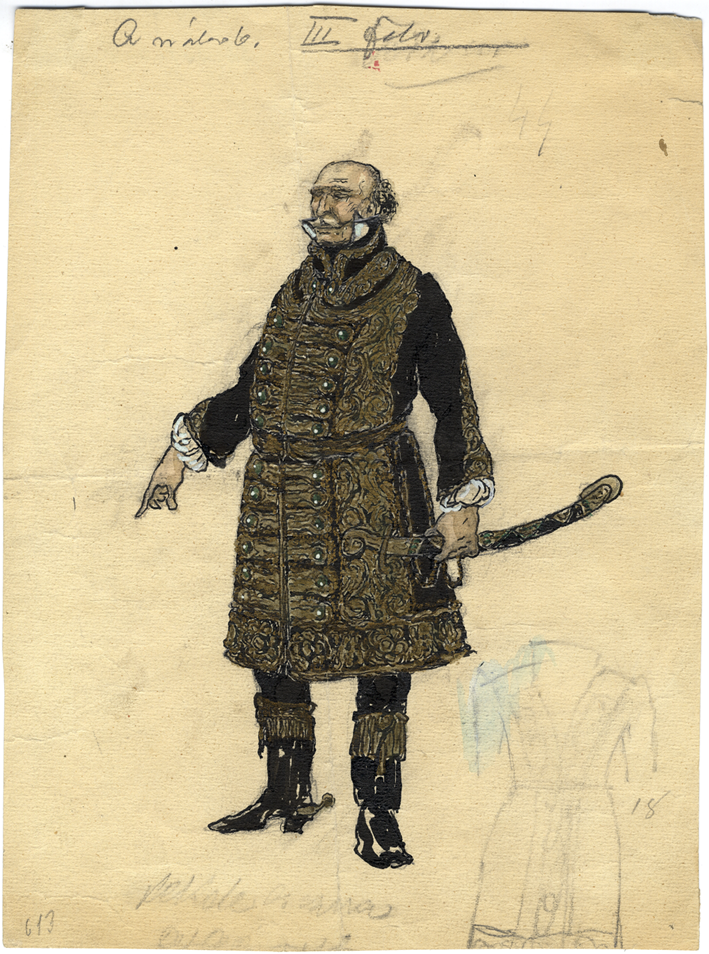
Picture 1. Egy magyar nábob, costume design by László Márkus, the nábob’s costume in Act III, Magyar Theatre, 1916 (OSZMI Scenic Collection, inventory number: 52.337.6.)
There was no continuation of Jókai’s works at the Magyar Theatre. At the end of December 1926, the Magyar Theatre company revived Az új földesúr with a new cast, with Jenő Törzs remaining from the old line-up.
In 1917, on the tenth anniversary of László Beöthy’s tenure, he summarised the achievements of the Magyar Theatre over the past period. A statistical report from the beginning of October shows that Egy magyar nábob was performed sixty-five times, while Az új földesúr and Kárpáthy Zoltán ran fifty-two times. A kőszívű ember fiai was not scheduled to be shown until the following year, in two parts. Beöthy managed to win Jászai Mari for the role of Mrs. Baradlay. Jenő Törzs played two roles: the elderly Kázmér Baradlay and his youngest son, Jenő. The first part of the two-night play is Mrs. Baradlay’s fight against her husband’s will, in which the mother ultimately wins, as she raises her children to be true, great Hungarian men. The second part is a stand-alone drama about the youngest Baradlay son, Jenő, who sacrifices himself for the lives of his brothers. The story of the novel is thus divided into two separate, organic dramas, and the two plays together form a cycle on the Hungarian War of Independence.
Az új földesúr was part of the curriculum at the turn of the 19th and 20th centuries, and even later in middle schools, commercial schools, and secondary schools. Thus, it quickly became a moderately priced weekend afternoon performance for the youth. Provincial theatres that adopted the play also ran it as an afternoon performance for young people. But other adaptations of Jókai novels also attracted young people. Regarding A kőszívű ember fiai, the journalist notes, “At every performance of the Jókai–Hevesi play, there are a large number of schoolgirls and young male students. They are a kind, sincere, enthusiastic audience, a refreshing sight in the theatre at a time when the audience is otherwise distracted by the fidgeting of coughing and cynical price gougers.”[20]
During Hevesi’s directorship, the National Theatre presented Egy magyar nábob,[21] in 1925 and Az új földesúr, directed by Árpád Horváth, in 1930.[22] The 28 September 1930 issue of Színházi Élet published Az új földesúr as a play supplement, including the cast. The former role of Jenő Törzs, General Ankerschmidt, was played by Gyula Csortos, Eliz by Erzsi Somogyi, Ádám Garamvölgyi by József Kürti, and Aladár by Árpád Lehotay.
At that time, Hevesi’s script attracted more critics than it had during its premiere in the Magyar Theatre. Now his entire career as a theatre director was being attacked, and he was under fire from all sides, so one has to search among the personal attacks and malicious criticism to find the reviews that are based on genuine professional observations. Critics raised the fundamental question of whether Jókai’s works could be dramatized in such a way as to preserve the charm of his poetry, his rich humour, the vividness of his characters, and how to choose a more dramatic form instead of narrating the essential events, and use his works to address today’s audiences through the stage of today.
Károly Sebestyén[23] wrote after the 1918 premiere of A kőszívű ember fiai:
“As far as we know, Sándor Hevesi’s guiding idea in dramatising Jókai’s novels was always to adapt as much of Jókai’s work as possible for the stage. This is a beautiful, clever, and selfless idea, one that involves sacrifice, homage to Jókai’s genius, and determination to promote the novelist with the powerful instrument of the adapting stage. Perhaps A kőszívű ember fiai does not need to be promoted today. Moreover, it is quite certain that Jókai’s novel will outlive the Jókai-Hevesi drama by centuries, just as Keresd a szíved[24] will be outlived by Fekete gyémántok. The task of the adapter exceeded his powers here again. But in general, I would not have the heart to dissuade Hevesi from continuing his work in this direction. There cannot be much that we do for Jókai. But it is also true that there are other ways to do something for Jókai.”[25]
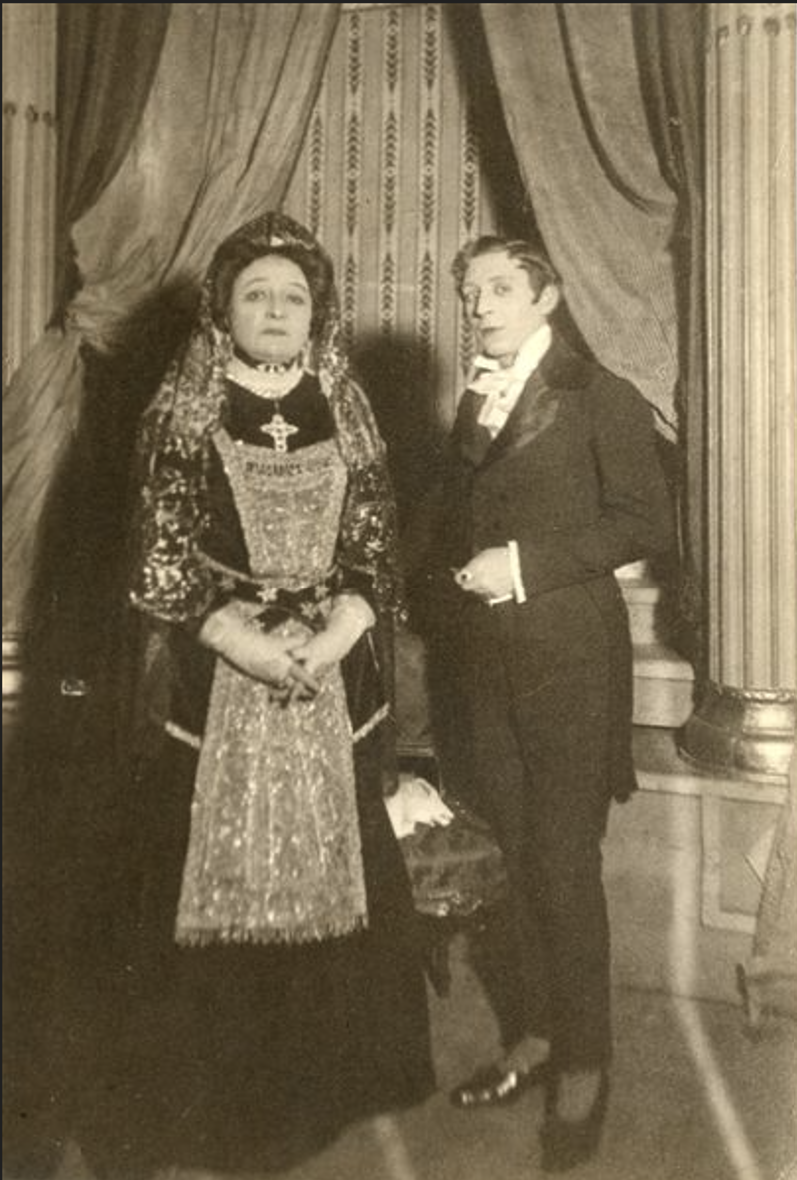
Picture 2. Mari Jászai (Mrs. Baradlay) and Jenő Törzs (Jenő Baradlay), A kőszívű ember fiai, Magyar Theatre, 1918 (photo by Gyula Jelfy, OSZMI Photo Library, inventory number: 53.6605_B1816.)
There is indeed a way to not only remember, but also to act, as Jókai did in those trying times for the Hungarian people: he revived national sentiment. Our most important task today can be none other than to strengthen our national identity.
[1] The members of the jury named in the first round were: László Beöthy, Ferenc Herczeg, Károly Bakonyi, József Márkus, Dr. Ernő Salgó, Béla Vágó, and Ákos Ráthonyi. Budapesti Hírlap, September 25, 1906, 13.
[2] “The most loyal spectator of A császár katonái was Mari Jászai, who proclaimed that she had never seen such a good performance on the Hungarian stage.” (Kellér 1964, 238.)
[3] Magyar Szinpad, September 24, 1917, 2.
[4] László’s father, Zsolt Beöthy, was influenced by Jókai in his early writing career, wrote a study of his work, and, as president of the Kisfaludy Society, bid him farewell at the great writer’s funeral.
[5] Sándor Hevesi to Lajos Fülep, Budapest, December 9, 1907, see Fülep 1990, 93.
[6] I have already mentioned this idea in an earlier work, see Galántai 2018, 47–48.
[7] Magyar Szinpad, September 6, 1913, 2.
[8] Ibid.
[9] Pesti Hírlap, September 7, 1913, 10.
[10] Statue of Jókai in Komárom. Budapesti Hírlap, September 9, 1913, 6.
[11] Az Ujság, September 7, 1913, 17.
[12] Nagybánya, November 27, 1913, 2.
[13] Miskolczi Napló, November 21, 1903, 2.
[14] Magyar Nemzet, November 20, 1903, 9.
[15] Bella Nagy played the role of Magda in Hermann Sudermann’s drama Heimat (Home) on 26 November 1898.
[16] Egy magyar nábob premiered on 1 April 1916 at the Magyar Theatre. Director, set designer, costume designer: László Márkus.
[17] The premiere of Kárpáthy Zoltán: December 15, 1916. Director, set designer, costume designer: László Márkus.
[18] The premiere of A kőszívű ember fiai: Part I – May 30, 1918, Part II – June 1, 1918. Director, set designer, costume designer: László Márkus.
[19] Magyar Szinpad, September 24, 1917, 2.
[20] Magyar Szinpad, June 14, 1918, 1.
[21] Mór Jókai and Sándor Hevesi: Egy magyar nábob. Directed by: Dénes Rádai. National Theatre, January 31, 1925. Revival: January 29, 1927.
[22] Premiered by the National Theatre on 5 September 1930.
[23] Károly Sebestyén (1872–1945) was a theatre critic, literary historian, philosophical writer, and literary translator.
[24] Jókai’s four-act drama Keresd a szíved was based on the novel A kőszívű ember fiai.
[25] Magyar Figyelő, July 1, 1918, 43–44.
References
- Fülep Lajos levelezése. Volume I. Edited, with notes and indexes compiled by Dóra F. Csanak. Budapest: MTA Művészettörténeti Kutatóintézet.
- Galántai, Csaba. 2018. Márkus László: A művészi létezés mestere. Budapest: MMA Kiadó.
- Joós, Ferenc. 1957. A vándorszínészettől az állami színházig: Kecskemét színészetének krónikája. Kecskemét: Bács-Kiskun Megyei Tanács VB Népművelési Osztály.
- Kellér, Andor. 1964. Bal négyes páholy. Budapest: Magvető.
- Török, Margit (ed.). 1988. A Thália Társaság (1904–1908). Budapest: Magyar Színházi Intézet MTA Lukács Archívum és Könyvtár.