“For how can we reach the present if we do not respect traditions?”[1]
Beyond its obvious necessity and practical purposes, clothing is also a very strong non-verbal signal. Attire is capable of rapid and effective communication without its wearer revealing a single word about themselves. As a concept connected to the past and tradition, clothing is capable of placing a person in space and time, as it allows us to form an idea about the wearer’s origin, cultural embeddedness, and belonging to a particular community, and even, in certain eras, their political orientation. Clothing is a telling language, whether we read descriptions of characters’ clothes in novels, see them as stage or film costumes, or see them on the street. However, it is important that we possess the knowledge necessary for understanding and decoding.
We can identify general rules and norms that can be adhered to or deviated from in dressing. Adherence to norms and the desire to stand out can therefore be fundamental parts of an individual’s personality, although it varies as to which appears more strongly in whom. The fundamental human desire, serving survival, is to fit into a group and to stand out from it. Since the end of the 17th century, following and renewing fashion has been increasingly linked with economic interests. Fashion is much more about wealth and status, while the concept of attire is linked to tradition and timelessness, although these concepts are often used synonymously.
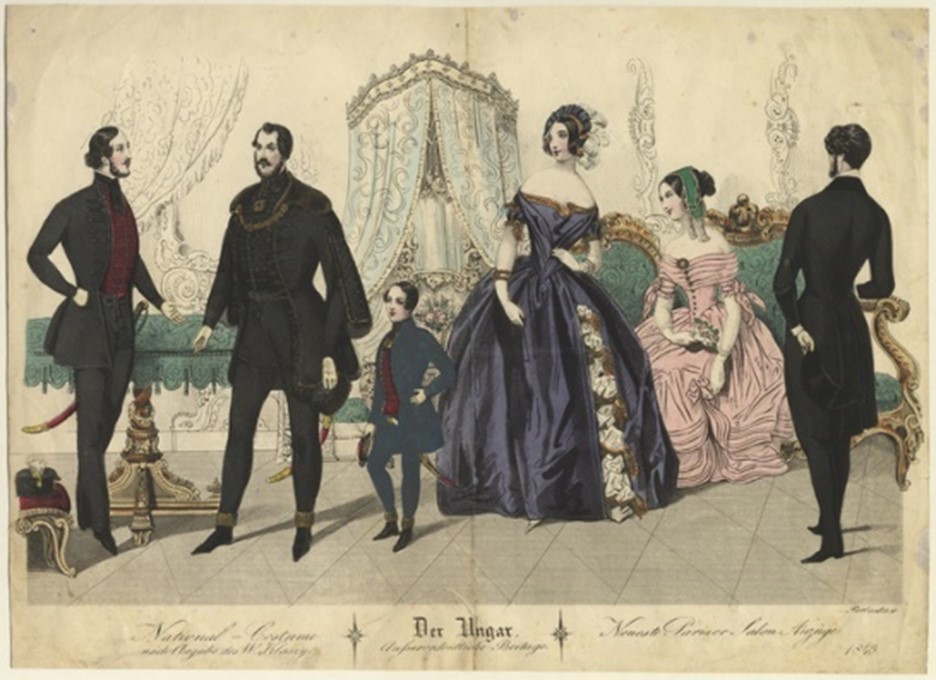
After the suppression of the 1848 Revolution and War of Independence—the national attire, based primarily on the traditions of the ceremonial dress of Hungarian nobility—became a true fashion in our country (for more on the topic, see: Lukács, 2017). But beyond that, it became associated with a movement aiming for ideals and thought, whose goal was to emphasize national unity and achieve self-determination and the rights of freedom. It is not surprising that those with economic interests also joined in the dissemination of national fashion, becoming its main driving forces. Famous tailors from Pest, primarily Ádám Kostyál, Vencel Klasszy, Gáspár Tóth, and Antal Eisele, made great efforts to ensure that the Hungarian garments renewed and made in a varied and high-quality manner by them, would spread widely. Taking advantage of the opportunities offered by the press, they regularly published fashion pictures in increasingly popular fashion magazines.
Picture 1. Domokos Perlaszka: Vencel Klasszy’s National Suits and the Latest Parisian Salon Dresses, 1843 (MNM KK, Budapest; photo: MNM Historical Gallery)
The aim was to reach and convince the bourgeoisie that the middle class also needed the attire that previously signified national affiliation only in the wardrobe of the aristocracy. It was a desired vision that clothing following national traditions would be not only festive, but also everyday wear. The simplified attire derived from ceremonial noble dress—referred to by the increasingly common term díszmagyar (ceremonial Hungarian attire) in the second half of the 19th century—was very diverse. Most often, it consisted of tightly fitted Hungarian trousers and a dolman, which, under the influence of Western fashion, could also be complemented by a waistcoat. The dolman, tailored at the waist, closely fitting the body at the top, and flaring out at the hips, was particularly popular. The name of the famous Hun leader became commonly used for its description, spelt both as “attila” and “atilla.” All three elements of men’s attire (trousers, waistcoat and dolman) were decorated with braiding, as were the bodices of women’s dresses and the loosely cut cloaks borrowed from men’s wear, matching the wide skirts supported by crinolines since the 1850s. A characteristic element of women’s attire was the bodice, closed by lacing or merely imitating it, and the apron, traditionally worn since the 16th century. It was an important question, and a subject of debate for a long time, whether elements of folk costume could be incorporated into the clothing of the aristocracy and the bourgeoisie (Lukács 2017, 54–60, 250–253). During the Reform Era, the idea of national unity gained increasing emphasis. In connection with that, it became increasingly clear that unified thinking prioritising national interests and the preservation of cultural identity were fundamental prerequisites for our national existence in a historical situation where a foreign, oppressive power sought to integrate Hungary into a multi-ethnic empire.
Mór Jókai and the National Fashion
Jókai enthusiastically and often emphasized the significance of national fashion in both verse and prose. Perhaps most clearly, he articulated the role and purpose of Hungarian clothing in his late, little-known novel Enyim, tied, övé (Mine, Thine, His), published in 1875:
“This national attire is our only weapon against foreign invasion. Wherever our spurred feet tread, that is Hungary. The world does not wish to hear our truth; therefore, let it see it on us in the form of buttons, braid, and feathers. And finally, let the people know from our clothes that we are equal to them, that we do not want to be masters over them; in America, even a day labourer dresses according to city fashion; in our country, even a magnate wears peasant attire: it makes no difference, and it is good.” (Jókai 1875.)
Celebrities of the era played a leading role in the popularisation of traditional decorative styles and garments that drew from both aristocratic and folk culture. Sándor Petőfi appeared in Hungarian attire on the streets of Pest even before the outbreak of the Revolution and War of Independence. Together with his wife, Júlia Szendrey, known for her eccentricity, they often wore unusual outfits that differed from bourgeois norms, using them to effectively draw attention to themselves, their literary work, and, at the same time, the importance of the nation’s cause. Jókai also mentioned his friend’s unusual appearance:
“Petőfi also started new fashions for himself. Once he wore Csokonai’s fur-lined coat, to the world’s astonishment; another time, he decided to have an attila made of floral atlas, and wore it with a contrived, crooked, yet not overly crooked hat to match, so that Pálffy once said of him: “When this Sándor comes to meet us, there is always something about him that makes one dream about him.” But this eccentricity suited him well, because he didn’t show off and was not pushy with it: it was his taste, and he didn’t force it on anyone else. He was the only man who never wore a top hat, never wore a tailcoat, and never went to the opera.” (Jókai 2018, 9.)
As the publisher of Pesti Divatlap, Imre Vahot also supported the unconventional appearance of his assistant editor, as he could direct attention to his newspaper with it. According to Jókai’s formulation, the Reform Era was still fundamentally a “tailcoat and top hat wearing era” (Jókai 2018, 8).
The true golden age of national attire, its emergence as a real fashion, could only come after the suppression of the Revolution and War of Independence and the difficult years of brutal reprisals. In his novel Enyim, tied, övé, the writer also notes that the 1848–1849 Revolution and War of Independence was fought “while maintaining European fashion alongside it, and Hungarian national attire only appeared in its place and on its person as a uniform, ceremonial dress, or folk costume. Now everyone wears spurs: as if no one wants to be an infantryman anymore” (Jókai, 1875).
In the general nature of fashion phenomena, it is particularly important who the fashion dictators were in a given era, whom society looked up to. The celebrities of the era played a significant role in the dissemination of Hungarian fashion. In the 19th century, in addition to the nobility, who always captured and represented the attention of the common people, politicians, actors, and other artists, especially popular writers, could be taste-makers. In the 1850s, Mór Jókai rose among the dominant, trend-setting figures of the era. His immense popularity, stemming from his literary work, was later supplemented by active political and public engagement. His family life, not free from scandals, also provided constant topics for the social public life of the era, always hungry for gossip. His first wife was no ordinary person, but Róza Laborfalvi, one of Pest’s most famous and leading Hungarian actresses. Both were fully aware of the importance of external appearance, and thus of clothing and presentation. Their decisions, choices, and stances left an imprint on the fashion history of the era and the memory of their contemporaries.
Jókai advocated for the importance of national attire at a very early stage, in 1856, and also pointed out that his colleagues and other celebrities who attracted public attention had obligations in this regard.
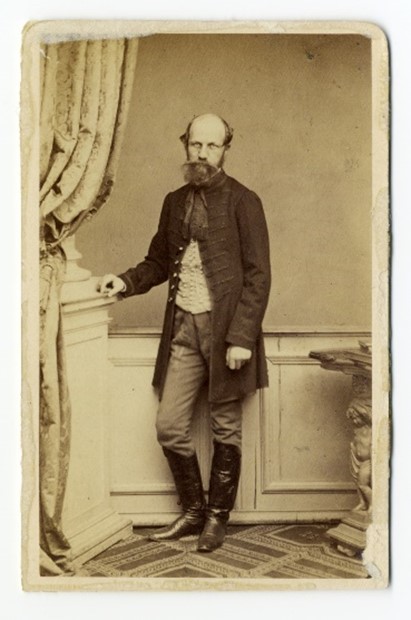
What happened was that the popular fashion magazine Hölgyfutár published portraits of twenty-four writers and actors as a supplement to the newspaper. Jókai praised the initiative, specifically highlighting how beautifully the gentlemen had tied their cravats. However, he reprimanded them because, out of sixteen men, only six had remembered to wear an attila: “The Hungarian writer and actor is first a patriot and only then a writer and actor. Let us overlook the tailcoat on each other in everyday life, as our father Adam wore it, but backwards, but on such an occasion where our pictures are presented to the nation, let us not be ashamed of that buttoned garment” (Jókai 1856, 238). Jókai himself set a good example; numerous photographs bear witness to the fact that until the second half of the 1860s, he was primarily photographed in Hungarian-style braided trousers and a Hungarian-style jacket, and he continued to wear his ceremonial Hungarian attire even after the Compromise—albeit only for representational purposes (E. Csorba 2018, 174–217).
As we will see later, Jókai served the cause of national attire in numerous and varied ways. Among these, his personal example could have had a great impact on his contemporaries.
Picture 2. Antal Simonyi: Jókai Mór, early 1860s (MNM KK, Budapest; photo: MNM Historical Photo Department)
Emőke Tomsics also emphasises this exemplary, almost dictatorial, fashion influencer role and the significance of photography as a modern, new medium: “The fashion of expressing national belonging through clothing coincided with the mass adoption of photography. We can reasonably assume that the sight of figures wearing everyday or festive Hungarian attire in albums and behind shop windows, including prominent politicians, artists, and aristocrats, had a considerable impact on the formation and strengthening of national sentiment” (Tomsics 2005, 50).
Mór Jókai’s niece, Jolán Jókay, wife of Sándor Hegedűs, was raised in the writer’s home and witnessed the daily lives and family life of her uncle and Róza Laborfalvi. Her memoirs, which were later published in book form, corroborate the image preserved in photographs. “In the early 1960s, when Hungarian dress was in fashion, Uncle Mór also wore Hungarian clothes. I remember how beautiful the fox-throat coat looked on his tall, slender figure, made of grenade-coloured cloth, with silver filigree buttons and trimmed with fox fur, a curly hat on his head, with a crane feather beside it”(Hegedűsné 1927, 136–137). His actress wife also did not relinquish her role as a fashion dictator; the same text states that “Aunt Róza also had a fox-throat coat; cornflower-blue cloth, also with silver buttons, trimmed with fox fur; instead of a hat, she wore a Hungarian headscarf; when she went out, she put a veil over the headscarf. I will never forget how beautiful they looked together.” Another eyewitness and memoirist, Mari Váli, a close relative as well, directly attributed the spread of national fashion to the couple, stating that “when one day he dressed in a carnelian-buttoned attila and a simple, braided cloth cloak thrown over his shoulder and took his pretty and beautiful wife wearing a silver-buckled bodice, a small velvet coat, and a gold-laced Hungarian headscarf for a walk, within a few days, as if by magic, the streets of Pest were teeming with figures in picturesque Hungarian attire” (Váli 1955, 218).
Not only family members, but also Mikszáth, a colleague who compiled Jókai’s biography, emphasized Jókai’s role in popularizing national attire: “Jókai was among the first to revive national attire. He praised it in verse and prose in Üstökös. […] Initially, it was worn only at ceremonies, but when some young noblemen, Count Béla Keglevich, István Esterházy, the young Balassa barons, took it to the streets, Jókai himself put on an attila and tight trousers, and Mrs. Jókai appeared on Váci Street in her Melinda bodice, in which ‘every woman was a hundred times more beautiful’” (Mikszáth 1907, 24).
Jókai’s poem Az a szegény frakk (That Poor Tailcoat), written under the pseudonym Kakas Márton, appeared on the cover of the 27 September 1862 issue of the newspaper. In his mocking, satirical poem, he condemned rapidly changing fashions and the abandonment of national elements.
His poem Magyar divat (Hungarian Fashion), written in 1859, is a more direct message and strong encouragement for the revival of national attire:
Again, again, let us wear
That coat, that dress,
Which our ancestors wore;
Old dolman, old hat
And those who lived and died for the homeland,
Will rise again.
Though to see, the frivolous
Here and there burst into laughter…
Let them laugh, they will soon stop:
Hungarians, do not be ashamed of yourselves!
Do not be ashamed of the attire,
In which your father could get by
And reached a happy old age.
Who knows from this happy time,
When the clothes turn around
The better year will also return!
Let him who denies a better future,
Turn his face away in a grimace.
You ask for it and believe that it will come.
Hungarians, do not be ashamed of yourselves.
Whose spurs jingle on his feet,
You know that he is not a coward,
Even if the gawker laughs.
The assassin and the coward
Do not wear spurs on their heels;
—He runs away, or lies in ambush.
You face them, you speak the truth,
Even if your heart bursts.
This is your old character:
Hungarians, do not be ashamed of yourselves.
In a golden-laced coif,
The female sex is so enchanting,
Like fairy women.
A virgin crown, not just worn,
But also deserved,
Shines on the forehead.
Miraculous times are upon us!
The heart of man swells.
Every woman is twice as beautiful:
Hungarians, do not be ashamed of yourselves.
Let Europe mourn
In sackcloth, in mourning frock coats
Its lost hopes.
If life is beautiful for us,
Who can judge us for that?
God is good, He will help!
Self-respect, patriotism
Let them be, if necessary, ‘fashionable,’
Whatever the world may say about it,
…Hungarians, do not be ashamed of yourselves!
Both poems were well known at the time, often recited in salons, amateur performances, and in front of smaller or larger audiences (“Doppler testvérek hangversenye”, 1861, 54). Magyar divat was one of Jókai’s most popular poems in the 1860s.
National fashion, which also served as political expression and was well-connected to the concept of passive resistance, began in Budapest in 1860, according to Jókai’s memoirs; he said that “from then on, for a few years, one could see all the specificities of folk costumes learned from various regions in every street, in every salon: the ruffled, fluttering headscarves, the pearl headbands, the lace aprons, the puffed shirt shoulders, the laced bodices for ladies; the attilas, coats, cloaks, spurred boots for men; the crane-feathered hats, the ornate szűr (a folklore coat), the shaggy guba (mantle) found their way into salons, and with them, the Hungarian words also, both written, spoken, and sung. During this time, Budapest, in all its social strata, displayed a truly Eastern national character. This lasted for four or five years; then it passed. It was long for fashion, short for national enthusiasm! Now, in the Hungarian capital, every class dresses as people in other European capitals do. We see national folk costumes only as a rarity” (Jókai 1893, 121). Indeed, after the coronation in 1867, adorned with the splendour of Hungarian ceremonial attire, the nation reconciled itself with its fate and its ruler. National fashion became outdated, as there was no longer anything to rebel against. Ceremonial attire remained as a spectacular costume for holidays, and both ladies and gentlemen returned to following Western fashion.
The National Fashion and costumes of the film A kőszívű ember fiai (The Baron’s Sons)
An important element of Jókai’s novels and, in connection with them, their film adaptations, is the concept of national uplift, the ideal of homeland and progress. The conflict between selfless and pure-hearted patriots and schemers who prioritize their own interests and acquired feudal privileges over the common good is the main motif of stories set in the mid-19th century. Costumes play a significant role in characterizing the figures, as they can reflect wealth and social status, personality, religious and national affiliation, and in many cases, political commitment.
The costume designer for Zoltán Várkonyi’s film A kőszívű ember fiai (The Baron’s Sons) released in 1965, was Rudolf Láng,[2] who had already worked successfully with the director in theatre. We know the life story of the artist, who fought for recognition his whole life, from his wife’s writings (Avar 1994).
Láng, who originally intended to become a painter, was born in Nagyszénás in 1904, as the fifth child of an intellectual family. His creations received mixed reactions, but in the difficult years following World War II, he had no opportunity to establish himself as an artist. Éva Ruttkai and Miklós Gábor, who lived in the same house, suggested he try to find employment in the National Theatre’s set painting workshop. In 1949, he received permission to enter the theatre’s studio without pay, where he was soon made a permanent employee and received a salary. It was here that he met his wife, who also worked as a set painter. In 1951, Endre Gellért invited him to the National Theatre as a scenographer. With his expertise in various stylistic periods and his exceptional and broad knowledge, he became an indispensable advisor to the theatre, where he not only gave art history lectures but also provided advice on cultural history and etiquette to the actors. His actual costume design career blossomed at the Vígszínház, where he drew nearly ten thousand figurines[3] over twenty years. It was at this theatre that he first worked with Zoltán Várkonyi, and as a further step in their fruitful collaboration, in 1965, he created costume designs for the director’s grand film, A kőszívű ember fiai. Their collaboration continued in Várkonyi’s other Jókai adaptations and in Egri csillagok (Stars of Eger). A small exhibition of Láng’s costume designs was held in 1965 at the Május 1. cinema, in connection with which Magyar Nemzet praised the character-forming power of his costumes: “His artistic imagination is enriched by vast knowledge, sure taste, and refined understanding of people” (S. M. 1965, 10). A picture of a true artist emerges before us, whom posterity remembers as both a painter and a graphic artist. He spoke about his costume design working method in an interview, unfortunately, only very briefly. “I dive into the script. I look for where the text ‘gives away’ something. Then the colour experience is born in me, and I try to put the figure I see onto paper with a few lines and splashes of colour” (S. M. 1965, 10).
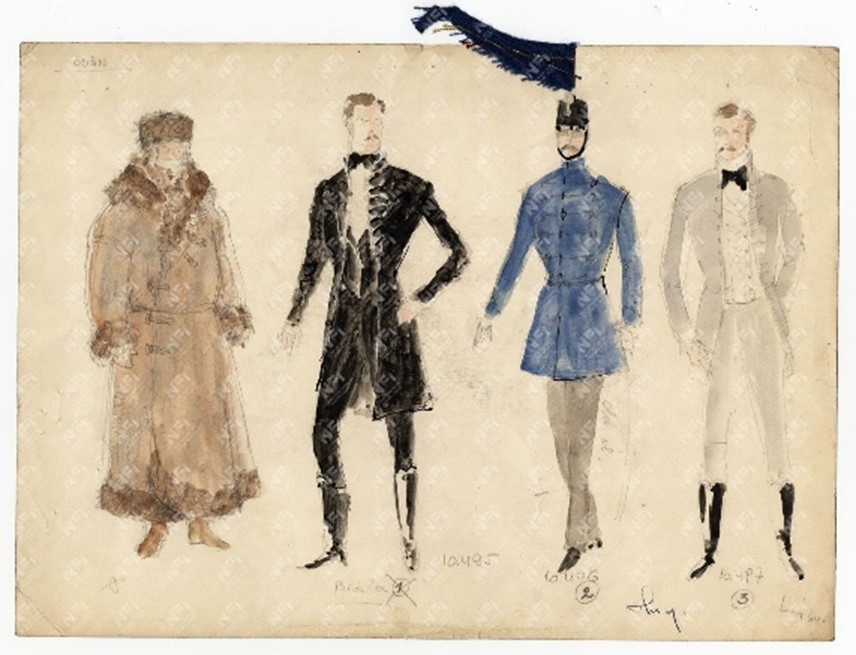
The costume designs for the A kőszívű ember fiai are preserved in the Set and Costume Design Archive of the Nemzeti Filmintézet (National Film Institute). For the purposes of our topic, the drawings made for Tibor Bitskey, who played Ödön Baradlay, are the most interesting.
Picture 3. Rudolf Láng: Ödön’s Costumes for A kőszívű ember fiai (The Baron’s Sons), 1964 (NFI Film Archives, Set and Costume Design Archive; HUNGART © 2025)
Of the three brothers, Richard is only seen in uniform except for the final scenes, while the youngest brother, Jenő, wears the fashionable men’s attire of the era: a tailcoat, waistcoat, and top hat. He is the one who only definitively commits to loyalty to the nation at the end of the story, and his attire throughout reflects the appearance of a fashionable Viennese gentleman. The surviving costume design presents us with four easily recognizable costumes for Ödön. The tailcoat, richly embroidered with metallic thread, which he wore in the Russian scenes at the beginning of the film, is omitted. The original garment, undoubtedly, was once worn by a secret councillor of the Austro-Hungarian Monarchy on the occasion of representative court ceremonies. The MNM Textile Collection[4] preserves the same type, but some pieces may have ended up with the Costume Rental Company, as well as theatre and film costume warehouses. Although the uniforms of diplomats were very similar, the metallic thread embroidery on the tailcoat seen in the film clearly places it in the wardrobe of secret councillors.
The first outfit shown on the design also belongs to the scenes set in Russian territories. The depicted fur hat and fur coat bear a closer resemblance to the costume worn by Colonel Leonin, Ödön’s friend, played by István Bujtor, during his journey in the harsh Russian winter. Here too, it is easy to imagine that the actors were dressed from the Costume Rental Company.[5]
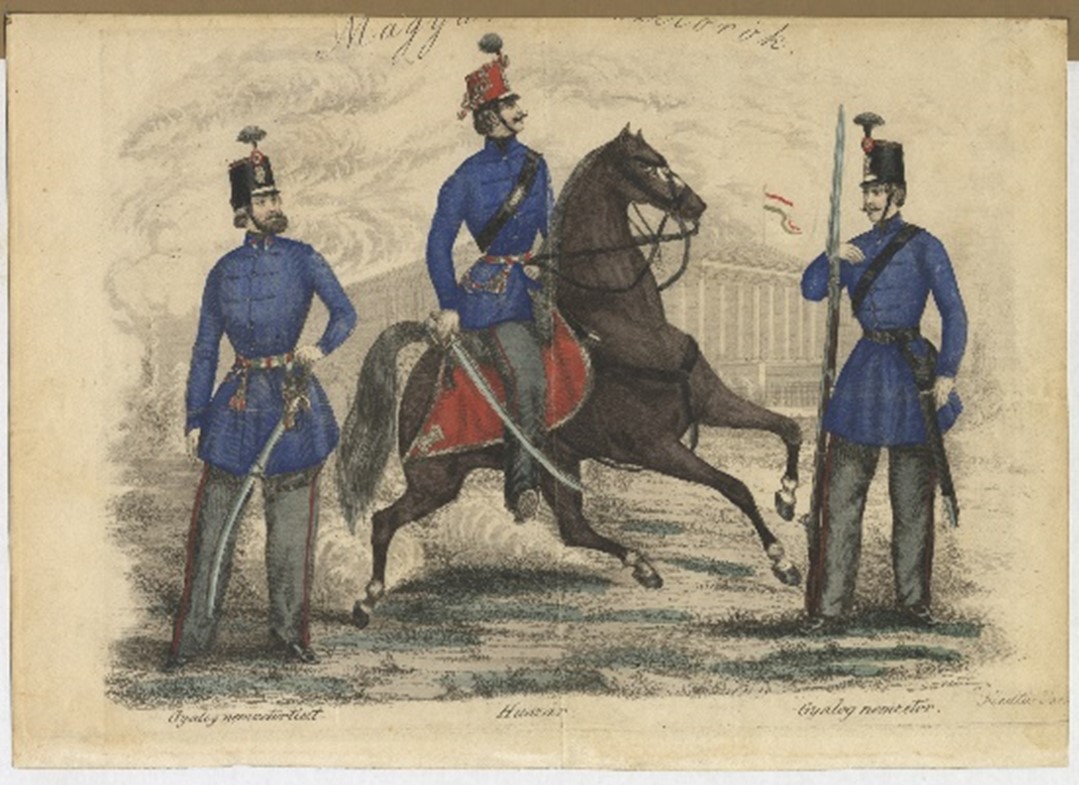
The uniform worn during the siege of Buda Castle could also be from the costume wardrobe, as it does not precisely follow the direction specified by the costume designer. The novel states precisely, though somewhat tersely, why and what uniform the character wore: “Ödön was as usual; neither more cheerful nor more gloomy. This time he wore his National Guard uniform. This could be explained by the fact that the soldiers were reluctant to look at civilian clothing walking among them. They believed that anyone who did not wear a sword at such times was a wimp.” The costume design shows that Rudolf Láng knew precisely that as a Captain, Ödön could not wear the regimental silver braid, only the simpler black one.[6] In the film, the uniform was further enhanced with a braided belt evoking national colours, which is also clearly identifiable in 19th-century depictions.
Picture 4. János Vidéky: Hungarian National Guardsmen, around 1849 (MNM KK, Budapest; photo: MNM Historical Gallery)
The black and grey outfit in the costume design is also a prime example of the 19th-century national fashion worn, sung about, and enthusiastically supported by Jókai. Although the film’s plot is set during the revolution, the inclusion of Hungarian attire is justified and corresponds to the established image of the era and audience expectations.
Costume history research already highlighted that the issue of national fashion was important during the Reform Era and part of public discourse, but it did not yet fundamentally define the streetscape. Hungarian attire existed before the 1850s but was not yet widespread. It only became a true fashion from 1859 onwards. In the film, it appears most often in the case of Bence Rideghváry and his entourage, indicating their belonging to the Hungarian nobility, even if their spirit is more loyal to the emperor. The great conspirator only wears the braided Hungarian attire in his county; when he is in Vienna, he does not present himself in national dress but rather wears the fashionable tailcoat and top hat, adhering to local customs.
With Rideghváry and his circle, we see that traditional attire does not signify political commitment on this occasion, but it can signify differences between nations. This is clearly visible when comparing the designs of the attire of the jurates and the Viennese citizens. Rudolf Láng designed national attire for the young Hungarians, while Western-style urban clothing for the Austrians. In scenes involving multiple characters, or many extras, it is particularly important for the viewer to be able to visually distinguish who belongs to which nationality and who is allied with whom.
Returning to the character of Ödön, the two Hungarian outfits on the design sheet clearly reflect the character’s spirit and commitment to the cause of the homeland. Of his siblings, he is the first and most steadfast to stand by his mother’s value set. He is a stable, active personality who finds strong ideological support in both his wife and his father-in-law (they also usually appear in Hungarian attire). Both outfits, in line with the 19th-century fashion, combine Western and Hungarian elements. Rudolf Láng designed black boots with curved tops for the tight Hungarian trousers. The braided dolmans and attilas are emblematic parts of Hungarian attire modernized during the Reform Era. The tie only appeared in Hungarian gentlemen’s attire in the 18th century, influenced by French fashion. By the 19th century, a special elongated form developed, usually cut from black silk and decorated with gold tassels at the ends. The shirt and waistcoat clearly show Western influence. Among the garments that are similar in cut but differ in colour and fabric, the grey one represented everyday wear, while the black one represented formal wear. The black set is seen when it becomes clear to the Hungarian gentlemen that the head of the Baradlay family will not be the emperor-loyal Rideghváry, but Ödön, the eldest son who inherited his mother’s rebellious blood. His elegant and ceremonial Hungarian attire, in which he accompanies his bride dressed in white, also complied with the rules of mourning. The wedding is held six weeks after the funeral. The young husband soon sets off to free his imprisoned father-in-law, arriving at the county assembly three days after the wedding.
At the scandalous assembly, which included violence, many extras wore noble ceremonial attire, known in the latter half of the 19th century as díszmagyar (ceremonial Hungarian attire). Most of these were original garments from heirs and illegal traders that had ended up at the Costume Rental Company. Ödön should also have appeared in a ceremonial Hungarian attire that emphasized his nobility but also complied with the mourning rules of the time. The writer also envisioned the scene this way (Jókai, n. d.): “It was Ödön Baradlay. In full ceremonial attire, which was also a mourning robe, a black velvet dolman, a dark grenade-coloured mantle, with blue fox fur, the same hat pushed onto his head, with a black heron feather, all buckles, clasps, and belt chains on his attire made of dark blue oxidized silver; his wide ceremonial sword with its belt in his right hand; he was in a hurry, he didn’t have time to fasten his sword.” In the film scene, Ödön rushed into the county assembly hall in his everyday grey attire, giving the impression that he didn’t even have time to change his travel clothes in his haste.
The analysis of Rudolf Láng’s costume design clearly shows that the designer had a thorough knowledge of the customs, lifestyle, and attire of the era. His works do not lack insight, the ability to paint psychological characters, nor aesthetics and decorativeness. As a costume designer for a historical film striving for realism, he performed precise, refined work, made possible by his observational skills and thorough knowledge of the subject matter. Over a decade of theatre practice and knowledge of objects could have been supplemented with research into visual inspirations. Unfortunately, we know very little about collaborations between museums and filmmakers, but it is certain that sometimes they sought the help of museologists, primarily on matters of warfare and weaponry. A thorough knowledge of the past provided a solid foundation for the designer, with which he could intelligently approach the novel to be adapted, thereby creating a connection between past and present that is also significant for the future.
[1] N., J. 1959. “Láng Rudolf: A jelmeztervezésről.” Film Színház Muzsika, May 8, 15.
[2] Zsazsa Lázár is also credited alongside Rudolf Láng in the film’s credits.
[3] Several of these are preserved by the OSZK (National Széchényi Library).
[4] MNM New Age Textile Collection, inventory number: 1953.34., as well as the Kunsthistorisches Museum Vienna, Monturdepot, inventory number: Monturdepot, U 979. Examples of diplomatic tailcoats include: Kunsthistorisches Museum Vienna, Monturdepot, inventory number: Monturdepot, U 977.
[5] According to the film’s credits, the costumes were made in the workshops of the Costume Rental Company.
[6] Thanks to Dr. Tamás Baczoni for his help.
References
Avar, Anikó. 1994. Láng Rudolf festőművész, 1904–1991. Budapest: Private publication.
“Doppler testvérek hangversenye.” 1861. Hölgyfutár, January 15, 54.
Csorba, Csilla (ed.). 2018. “Egy ember, akit még eddig nem ismertünk”: A Petőfi Irodalmi Múzeum Jókai-gyűjteményének katalógusa – Tárgyi hagyatéka, díszalbumok, képzőművészeti gyűjteménye, fényképgyűjteménye. Budapest: Petőfi Irodalmi Múzeum.
Hegedűs, Sándorné Jókay Jolán. 1927. Jókai és Laborfalvi Róza. Budapest: Singer és Wolfner.
Jókai, Mór. 1856. “Irodalom és Művészet.” Vasárnapi Ujság, July 6, 238.
Jókai, Mór. 1875. Enyim, tied, övé. Online access: https://mek.oszk.hu/00700/00774/html/jokai29.htm (last visited: October 16, 2025).
Jókai, Mór. 1893. “Budapesti élet.” In Az Osztrák–Magyar Monarchia írásban és képben. Volume IX, 119–192. Budapest: Magyar Királyi Államnyomda. Online access: https://mek.oszk.hu/00800/00836/html/jokai70.htm (last visited: October 16, 2025).
Jókai, Mór. 2018. Az én kortársaim: 1848-as emlékek. Budapest: Magyar Elektronikus Könyvtárért Egyesület. Online access: https://mek.oszk.hu/18800/18835/pdf/18835.pdf (last visited: October 16, 2025).
Jókai, Mór. N. d. A kőszívű ember fiai. Online access: https://mek.oszk.hu/00800/00829/html/jokai31.htm (last visited: October 16, 2025).
Lukács, Anikó. 2017. Nemzeti divat Pesten a 19. században. Budapest: Budapest Főváros Levéltára.
Mikszáth, Kálmán. 1907. Jókai Mór élete és kora. I–II. Budapest: Révai Testvérek Irodalmi Intézet Részvénytársaság. Online access: https://mek.oszk.hu/00900/00945/html (last visited: October 16, 2025).
N., J. 1959. “Láng Rudolf: A jelmeztervezésről.” Film Színház Muzsika, May 8, 15.
S., M. 1965. “Láng Rudolf kosztümtervei a Május 1. filmszínházban.” Magyar Nemzet, February 7, 10.
Tomsics, Emőke. 2005. “Nemzeti identitás és fotográfia.” In Kulturális örökség – Társadalmi képzelet. Budapest: OSZK—Akadémiai Kiadó.
Váli, Mari. 1955. Emlékeim Jókai Mórról. Budapest: Szépirodalmi Könyvkiadó.