Introduction
The aim of this case study is to show what national identity concept may be drawn from Mór Jókai’s play Olympi verseny (Jókai 1893). The subtitle of the play is Ábrándkép a budapesti Nemzeti Színház ötven éves fennállásának ünnepére (A Vision for the Fiftieth Anniversary of the National Theatre in Budapest), commemorating an institution that became a key organisation in the process of Enlightenment, nation building, and Language Reform—that is, the formation of national identity—in the 19th century.
The idea of revitalisation of Hungarian drama and theatre also appeared in discourses introducing the Reform Era and the Language Reform. The creation of Hungarian literature, translations, and original Hungarian dramas, comedies, and other literary works was already advocated by György Bessenyei in his programme. In his pamphlet Magyarság (Hungarianness), he wrote that plays written in Hungarian were needed to raise the level of education and knowledge:
“Why should a nation not be able to write in its own language for its own amusement? And why would it not be nice to make one’s country laugh with a comedy or a Pontyi? Let everyone go where they can go. Now is the time to raise the Hungarian nation. Why should the great university of Buda not be able to affiliate itself with Hungarians who know the language of their homeland, on an honorary basis, without pay? It would be good to create a new dictionary, in which new Hungarian words would be defined. The university could take it upon itself to examine and print good Hungarian books. It could have Cicero, Epictetus, Seneca, Rollin, Milott, Hübner, etc. translated into Hungarian. Let it also be possible to study in Hungarian; such works would be bought, and thus the university would have money and the nation would have Hungarian books.” (Bessenyei 1778, 16.)
In 1832, István Széchenyi proposed the construction of a permanent Hungarian-language theatre in his work titled Magyar játékszínrül (On Hungarian Theatre). “He published it at the invitation of the committee sent from the county to spread the Hungarian language, which contained his thoughts on the revival of the theatre” (Gárdonyi 1941, 8).
According to Széchenyi, the National Theatre project was off to a difficult start: “In Hungary, the establishment of a permanent Hungarian theatre is an objective that is sensitively desired by many; countless sacrifices have already been made, but Hungarians have yet to achieve any success in this, as in so many other matters. […] The goal is nothing less and nothing else than to allow our homeland to enjoy the pleasures and benefits of theatre in general” (Széchenyi 1832, 5–7).
And why is it important to create a National Theatre with a permanent company? Because it develops and disseminates the Hungarian language, shapes taste, educates the Hungarian-speaking audience, and—last but not least—entertains them: “First and foremost, the joy of contributing to the development, refinement, and ennoblement of the national language, taste, and customs in the most effective way possible; and then, the pleasant pastime that flows directly from a well-organised theatre to the audience” (Széchenyi 1832, 9–10).
He also had a concrete idea of the location of the National Theatre: “…no general theatrical success—and this is what we need—will ever develop to any degree of perfection, either in Kassa, or in Miskolc, or in Pécs, or in any other notable place in the country, no matter how many centuries pass until a proper, indestructible theatre is erected in Buda-pest” (Széchenyi 1832, 17–18).” Széchenyi originally envisioned the building on the bank of the Danube, but it was eventually built elsewhere.
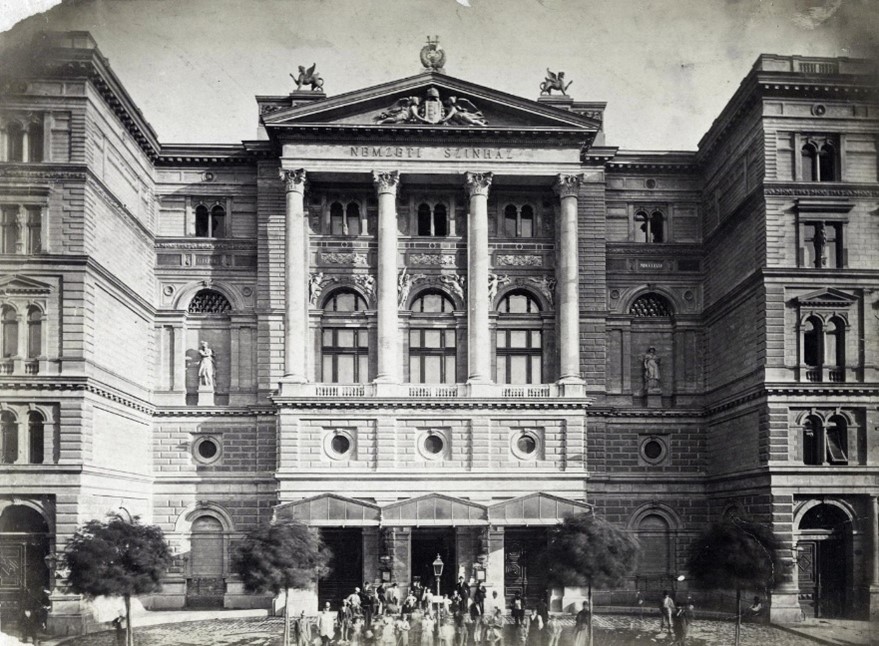
The location of the National Theatre was fatefully uncertain from the moment it was founded. Finally, after some delay, construction of the first building began in 1835 in Kerepesi út (now Rákóczi út 3), and opened on August 22, 1837, under the name Pesti Magyar Színház (Hungarian Theatre of Pest), then from 1940 it operated as the National Theatre.
Picture 1. The building of the National Theatre between 1880–1890 (Fortepan / Budapest City Archives. Archive number: HU.BFL.XV.19.d.1.05.083. Year: 1900. Picture number: 82138.)
The building was intended to be temporary from the outset, and following extensions and renovations, fifteen years after the publication of Jókai’s play, the company finally moved out in 1908 for fire safety reasons. It was then that the state rented the iconic building of the People’s Theatre on Blaha Lujza Square for the purposes of the National Theatre, also on a temporary basis, but that is a story for another time (see National Theatre, n. d.).
On identity
Our identity is a layered, complex system with many components, ranging from the personal to the group and the national, which manifests itself in both the physical and the virtual space. “Identity is a uniquely organised cognitive structure that develops during the process of social integration, growing into one’s environment, or, in technical terms, socialisation. Language is part of a person’s cognitive equipment, and as a result, all of our mental activity, including the formation of identity, takes place through language and the mediation of language” (Kiss 2017, 806). Also: “A sense of identity is one of the fundamental conditions of human existence, and one of the most characteristic forms of collective identity is national identity…” (Bitskey 2007 cited by: Péntek 2010, 161). The Hungarian language has symbolic value in the formation of Hungarian national identity (Péntek 2010, 161–162).
According to my interpretation, identity is a set of answers to the question “Who am I?”, a fundamental part of our self-identification, a complex, multifactorial concept in which language plays a crucial role (Bódi 2020, 10). Hungarian-language theatre plays a central role in the dissemination of culture, and through the use and dissemination of the Hungarian language it makes a fundamental contribution to the development of national identity.
Structures associated with identity
In Mór Jókai’s play Olympi verseny, the past and the present are two personified ideals appearing in a national context, i.e., theoretical categories, basic concepts that serve as orienting models, that is, part of the system of norms. In addition to the present, the past is also a natural element of the identity of the individual and the community, therefore in my analysis I will highlight the components of the ideals of Past and Present, personified by Jókai, along with the concepts and expressions that refer to these ideals. I organise the descriptions in the play that are related to the concept of identity into thematic groups. The thematic groups are:
- tradition and fashion,
- passive and active elements,
- opposition and belonging,
- ideal and enjoyment,
- eternal values: immortality and eternal youth;
- the historical past, the unreal/idealised/ideal past and the realistic present;
- symbolic elements: the capital and the buildings that define the national identity of the capital;
- the national language,
- the arts,
- the national character.
Tradition and fashion
The description of the set design indicates that the past is based on classical traditions (Roman clothing), while the present is fashionable. Traditions based on classical values are therefore just as much a part of defining our identity as the currently popular, temporary phenomenon of fashion.
“On either side of the stage, in the foreground, stand two Ideals: Past and Present, female figures. One is dressed in ancient Roman attire, the other in contemporary fashion.” (Jókai 1893, 373.)
It becomes apparent in the presentation of Past and Present, which embody the characteristics of tradition and fashion, and throughout the play that these two phenomena are opposites and yet inseparably connected:
“Siblings and enemies, born of each other, inseparable and not existing together, the names of these twin companions are ‘Past’ and ‘Present.’” (Jókai 1893, 374.)
Our identity is just as multifaceted: a combination of elements that are distant and close, but which are in any case interconnected.
Passive and active elements
It is noteworthy that both personified female figures emit light, i.e., illuminate: the past passively (reflecting), the present actively (holding a torch in her hand). A mirror held in the hand of the past reflects light in the direction it is turned, and it is in the mirror of the past that we see ourselves, i.e., it is the past that makes the present visible and understandable. And the present holds a magic torch, i.e., enchants with its light and has active creative power. Identity also consists of passive, stable, and permanent values, and an equally important part of it is the value system that actively and creatively shapes our character and self-definition.
“Past holds a magic mirror in her hand, with which she sheds light in the direction it turns. Present has a magic torch in her hand.” (Jókai 1893, 373.)
If we wish to draw conclusions about Jókai’s concept of national identity based on the above, we can conclude that it is the sum of the past, based on classical traditions, and the fashionable present, which together are necessary for (self-)interpretation. Identity includes a passive, solid value system and an active, creative force of reinterpretation.
Opposition and belonging
The past and the present are opposed to each other, but they appear together on stage, both being necessary elements of self-interpretation. Symbolic opposites emerge, such as darkness and light, sibling and adversary. Identity is a similarly multi-layered system with many different components.
ORACLE Who are you?
PAST Siblings and opponents.
PRESENT Twins, born from each other.
PAST Never together; but inseparable.
My name is: transparent darkness,
In which all that was is seen.
PRESENT Mine is the gloom woven from rays of light,
Through which none of what will be is seen.
(Jókai 1893, 373.)
Our existence is therefore the relation between the past and the present. The present is unintelligible without the past; and while the past and the present are sharply divided, they cannot exist without each other. This is also a rhetorical device: it uses opposition and contrast to reinforce the interaction, since the opposing factors cannot be interpreted without each other (cf. Adamikné 2010, 307–309).
Ideal and enjoyment
The ideal is rooted in the past, and these are the basis of the present system of purpose, i.e. life, heart (emotion) and passion. The most characteristic symbols and concepts of the ideal rooted in the past in Jókai’s play include classical arts, ancient theatre (cothurnus), lofty, full of pathos, strong in battle, tough in body and soul. “This is the flower, the foliage and the fruit of our trunk” (Jókai 1893, 382.)
And the momentary nature of the present is illustrated by Jókai with such symbols and concepts as clichés, patterns picked up here and there, the crazy whims of demons, sentimental nonsense, lamentation, false pathos, exaggeration, whining, man fallen from his pedestal, real, complete, understandable, ordinary man with his faults and virtues; the world of the heart, desires, vanity, passion.
What transpires from Jókai’s symbolism continues to be relevant today: our self-definition is not only based on the fleeting, momentary, emotional, and pleasurable values of the present, but must also include a system of norms rooted in the past and passed down through generations.
PRESENT And who is this pale figure? This sad Hungarian?
PAST This is your ancestor, the wandering minstrel,
A poet and actor in one,
With the whole orchestra in his hands,
That cobza—here they are, the three of them together;
The poet, the lute, and the storm in the sky
Travel the country and sing
Of days gone by, of heroes, of the glorious;
And of their long suffering.
(Jókai 1893, 379.)
Eternal values: immortality and eternal youth
The past is immortal, but the present is forever young. In Jókai’s play, viewed from the present, the past is underdeveloped, outdated, and ridiculous, but from the perspective of the past, the present is not of better quality, but only clichéd, overly earthbound, and worldly, because those in the present do not act according to normative ideals, but live for the moment, are not pathetic, but follow the patterns of present life, and are superficial and shallow. In rhetorical terms, therefore, Jókai’s portrayal of the present lacks both ethos and pathos, whereas both of these are found in the past. Without ethos, pathos and logos, persuasion and argumentation are not valid, credible and effective (see Adamikné–Adamik–Aczél 2004, 267). Just as our past and the value system rooted in it are an essential part of our identity.
The values of the past are solid, serving as eternal points of reference, and norms only crystallise in the perspective of time—this is the connection Jókai depicts in one of the utterances of Past:
“I saw this hall come into being.—
When the first foundations were laid
For the humblest of dwellings
By great men—their fame was small,
But their deeds were great.
They are gone, forgotten,
But the stone they built lives on!”
(Jókai 1893, 380.)
The idealised historical past and the realistic present
The Hungarian national past is combative, serious, and unplayful, strong in body and soul. Among the many misfortunes, Jókai highlights the Turkish occupation, and these misfortunes are useful because through them we learnt what pain was. The role of art is to convey all this in an authentic way. In Jókai’s play, Sebestyén Tinódi Lantos, who authentically represented the past, is the iconic figure of the artist who lay the foundations of national identity.
From today’s perspective, however, our past, full of misfortunes, is too sad, and the Turkish occupation does not need to become part of our national identity, as it is foreign.
The memories of the past are kept alive by artists who depict our historical events, and who may be interpreted as the ancestors of present-day theatre: thus, the values of the present grow out of the memories of the past.
According to the rhetorical counterpoint, however, from the present perspective all this is just a fairy tale that can and must be forgotten; from the present perspective the past is incomprehensible, but the present is understandable and real.
Jókai alludes to the relativity of the truthfulness of the past and the present when he emphasises that the present embellishes the past: the past is not as glorious and beautiful as we think today. The foundations of our identity are therefore relative.
Jókai’s foresight and logical reasoning are demonstrated by the fact that, somewhat surprisingly, he also articulates one of the most important dilemmas of a very modern, 21st-century interpretation of identity:
“The faster pulse of national life
Opened up new horizons for the poet,
And with it a new path for the artist.
And no longer is our beautiful country locked around:
We are now part of the wider world,
In the past, only in the heart of our country
Did we compete with educated foreigners!
Now our competitor is the whole world.”
(Jókai 1893, 387.)
So, in terms of identity interpretation, there is a contrast between the dominance of national elements and competition between the world’s nations, i.e., international competitiveness.
Symbolic elements of the capital
Jókai places particular emphasis on Budapest, the nation’s capital, which is the “heart of the Hungarian homeland,” but the memories of past losses only weaken the self-identity of those living in the present.
“What a heartbreaking sight this is?
A cemetery covered with Turkish tombs.
Dark bastion ruins, rotten palisades,
Which are perishing in the thicket. There, the pale
Sky is pierced by Turkish mosques.—
Why do you call this the land of my cradle?”
(Jókai 1893, 378.)
In the following author’s instruction, it is worth noting that Jókai highlights a set of iconic sites and buildings that symbolise Hungarian identity:
“…there is a bird’s-eye view of Budapest as it is today, with the National Theatre, the Opera House, and the People’s Theatre in the foreground; Buda with the completed Royal Palace and with Matthias Church in the background, and the bright daylight behind.” (Jókai 1893, 380.)
The national language
One of the most important components and symbols of Hungarian national identity, the Hungarian language (Péntek 2010, 165) and its most important medium, the national theatre, come to the fore. In the past, the performing arts developed in a sophisticated language, which is one of the most important factors shaping national consciousness. The basic ideas of the Enlightenment, the Reform Era, and Language Reform resonate here: the creation of the Hungarian literary language, the revitalisation of Hungarian-language drama, the establishment of a national theatre, and we are right here, because this play was also created specifically for the anniversary of the National Theatre. It is a fair conclusion that the National Theatre is one of the most important and central symbols of Hungarian national identity.
About a sophisticated national language, Jókai remarks that it should be understandable to both the patrician and the citizen. This idea may be a precursor of the need for intelligibility, which is a central focus of the current language strategy and still a major problem (Bódi 2023, 45). Moreover, it is also part of the European and even American language strategy programmes (EUHWC 2015, FPLG 2011, Bódi-Katona 2025).
“But they had to eradicate from themselves
That which was incompatible with the spirit of the nation:
The antiquated customs,
The sentimental whining and lamenting.
The cloud-bursting pseudo-pathos, exaggeration,
The half-hearted, whining, false emotions fashionable
In the travelling troupes’ tarpaulin tents,
And instead create anew
Manners, movements, recitations
Derived from the ancient truth, the nature of the nation.”
(Jókai 1893, 382.)
Part of Jókai’s concept of the national language is that it is in our language that we truly know ourselves, and that it is therefore what truly defines our identity. This is in line with the theories of today’s researchers cited above.
The arts
We also gain insight into the identity-forming power of art. According to Jókai, art is rooted in the national past and portrays the glorious figures of the past—those living in the present recognise themselves in the glorious characters of the past.
“The poet arrived and opened up
New regions for national art,
Bringing to life the powerful, glorious figures
Of our ‘great’ history,
Into whom the artist breathed his flame,
Like two demi-gods, who merged into one,
The poet and artist became creators.”
(Jókai 1893, 382.)
If we move onto the aesthetic plane, then from today’s perspective, art is no longer a tool, and therefore no longer a means of defining identity, but exists only for its own sake: “Today art is an end in itself” (Jókai 1893, 385). It is constantly pointed out that the past is the world of ideals, while the present is the world of reality, and that the theatre of the present must represent modern man, not the ideals formed in the past. At the same time, it is becoming increasingly clear that the reality of the present grows out of and is based on the ideals of the past, without which it is unintelligible.
“Today the concept of a people is a world.
Different people, new class, new company.”
(Jókai 1893, 386.)
“We are now part of the wider world.
In the past, only in the heart of our country
Did we compete with educated foreigners!
Now, our competitors are the whole world:
And we must reach the same level
As the ancient art of great families of people.”
(Jókai 1893, 387.)
The national character
Returning to the nation-building power of art, theatre and literature, Jókai believed that the national characteristics of Hungarian identity were as follows: the Hungarian people live on plains of mirage, dwell in thatched huts and revel in taverns: “This is the flower, the foliage and the fruit of our trunk” (Jókai 1893, 382).
The role of art is to present identity to the nation, to reinforce it, and it is through art that the nation recognises itself. Folk songs, Hungarian music and Hungarian theatre are important elements of national identity.
The rhetorical structure of the work
For the sake of interpretability and illustration of the theme, and not least for the sake of theatrical presentation, Jókai personifies the past and the present in the form of two female characters. The author therefore employs the tool of metaphorisation, and, more specifically, anthropomorphism.
“On either side of the stage, in the foreground, stand two Ideals: Past and Present, female figures. One is dressed in ancient Roman attire, the other in contemporary fashion.—Past holds a magic mirror in her hand, with which she sheds light in the direction it turns. Present has a magic torch in her hand.—In the center, on a tripod is a large bust with a mask; the messenger of the Oracle of Delphi, with a flame burning on the altar in front of her.” (Jókai 1893, 373.)
The text takes us through the dialogue between the personified Past and Present, which is personal but does not become personal. So, Jókai is not manipulating, he merely makes something that is abstract and theoretical understandable and worldly. The concrete embodiment and interpretative framework of the abstract and theoretical concept of identity is the past and the present. This is true not only in Jókai’s play, but also in general.
Jókai introduces the past and the present as ideals of equal rank, neither one superior to the other, with the two personified figures participating in the dialogue as equals: “On either side of the stage, in the foreground, stand two Ideals: Past and Present, female figures” (Jókai 1893, 373).
The unity of ethos, pathos, logos is beautifully delineated in the play. Ethical principles are relative in terms of the rhetorical structure of the work, because viewed from the present, the past is underdeveloped, outdated, and ridiculous. But the present, from the perspective of the past, is not of better quality, it is clichéd, too earthbound, because people today do not act according to classical values, but live for today, and the patterns of present life are superficial and shallow compared to those of the past.
The pathos, or the elevated tone appropriate to the situation, is in fact associated with the past in the rhetorical structure of the work: Roman attire, the heroism evident in our historical traditions, and the mission of art to describe a glorious historical past. The comprehensibility of literature and its appropriateness to the situation and audience are fundamental requirements.
“But they had to eradicate from themselves
That which was incompatible with the spirit of the nation:
The antiquated customs,
The sentimental whining and lamenting.
The cloud-bursting pseudo-pathos, exaggeration,
The half-hearted, whining, false emotions fashionable
In the travelling troupes’ tarpaulin tents,
And instead create anew
Manners, movements, recitations
Derived from the ancient truth, the nature of the nation.”
(Jókai 1893, 382.)
Finally, logos may be observed in the rhetorical structure of the entire work. The main rhetorical device is juxtaposition, contrast, which is not contradiction. Thus, two opposing characters, ideas, or conceptual categories are juxtaposed from many aspects, and the conclusion reveals the weighing (Adamikné 2010, 307-309). And the conclusion is based on compromise. According to Jókai, the ideals (norms) of the present can be interpreted from the perspective of the past. The present also appreciates the glory of the past, the great authors of the past, the beauty of language, and from this comes the value system of the present.
ORACLE The contest is over. My verdict:
‘The laurel is precious which the happy living
Place from their forehead upon the head of the departed.’
PRESENT Let your word be followed, O goddess!
‘The laurel is precious which the happy living
Place from their forehead upon the head of the departed.’
(Jókai 1893, 388.)
If we evaluate the Oracle’s verdict from the perspective of national identity, which is the focus of our inquiry, we see that our national identity is based on our national past, history, and traditions, and that all of this is conveyed through the arts, literature, and theatre through the national language.
The conclusion is indeed a compromise, because in the last monologue of Present, we read that the glory of the present is based on the traditions of the past, and the Oracle’s logical conclusion after this is that the metaphor of glory, the laurel wreath, is placed on the head of the Past.
“A glorious heritage! This is undeniable!
But none of it has been wasted:
We have lost nothing of our traditions…”
(Jókai 1893, 387.)
References
- Adamikné Jászó, Anna. 2010. “Ellentét és ellentmondás.” In Adamik, Tamás (editor-in-chief): Retorikai lexikon, 307–309. Pozsony: Kalligram.
- Adamikné Jászó, Anna, Tamás Adamik and Petra Aczél. 2004. Retorika. Budapest: Osiris.
- Bessenyei, György. 1778. Magyarság – A magyar néző. (Magyar irodalmi ritkaságok XVI.) Budapest: Királyi Magyar Egyetemi Nyomda, 1932. Online access: https://real-eod.mtak.hu/7984/2/MTA_Konyvek_867494_2.pdf (last visited: May 5, 2025).
- Bitskey, István. 2007. “Az identitástudat formái a kora újkori Kárpát-medencében.” In Bitskey, István and Gergely Tamás Fazakas (eds.): Humanizmus, religio, identitástudat: Tanulmányok a kora újkori Magyarország művelődéstörténetéről, 11–23. Debrecen: Debreceni Egyetemi Kiadó.
- Bódi, Zoltán. 2020. “Digitális identitás – nyelvi identitás – digitális kommunikációs környezet.” Információs Társadalom 20(3): 7–26.
- https://dx.doi.org/10.22503/inftars.XX.2020.3.1
- Bódi, Zoltán. 2023. “A magyar hivatali nyelv és a nyelvi identitás kapcsolata.” In Bíró, Csilla and Dóra Nagy (eds.): A Magyarságkutató Intézet évkönyve, 2022. Budapest: Magyarságkutató Intézet.
- Bódi, Zoltán and József Álmos Katona. 2025. “Language planning issues of Hungarian legal language and the clear writing programme as a possible solution.” Current Issues in Language Planning 26(1): 102–119.
- https://doi.org/10.1080/14664208.2023.2283653.
- European Commission, Directorate-General for Translation and Zeta Field. 2015. How to write clearly. N. p.: Publications Office of the European Union. Online access: https://data.europa.eu/doi/10.2782/022405 (last visited: October 10, 2025).
- Plain Language Action and Information Network. 2011. Federal plain language guidelines. N. p.: n. p. Online access: https://www.plainlanguage.gov/guidelines (last visited: May 5, 2025).
- Gárdonyi, Albert. 1941. “Széchenyi István szerepe Budapest fővárossá fejlesztésében.” In Dr. Némethy, Károly and Dr. Budó Jusztin (eds.): Tanulmányok Budapest múltjából , 1–31. Budapest: Budapest Székesfőváros.
- Jókai, Mór. 1893. “Olympi verseny: Ábrándkép a budapesti Nemzeti Színház ötven éves fennállásának ünnepére.” In Jókai, Mór: Színművek. Volume 2, 371–388. Budapest: Franklin Társulat. Online access: https://mek.oszk.hu/18700/18735/pdf/18735_2.pdf (last visited: May 5, 2025).
- Kiss, Jenő. 2017. “Identitás és anyanyelv a magyarság történetében.” Magyar Tudomány 180: 805–809.
- Nemzeti Színház. N. d. Történeti áttekintés. Online access: https://nemzetiszinhaz.hu/torteneti-attekintes (last visited: May 5, 2025).
- Péntek, János. 2010. “Anyanyelv és identitástudat.” Debreceni Szemle 10(3): 160–168.
- Széchenyi, István. 1832. Magyar játékszinrül. Pest: Füskúti Landerer. Online access: https://mek.oszk.hu/09700/09707/09707.pdf (last visited: May 5, 2025).